Squander
Watching the world turn upside down in the era of constant information:
In theory, big countries should dominate all sports because they have the biggest talent pool. But they don’t, because societies squander their talent.
Watching the world turn upside down in the era of constant information:
In theory, big countries should dominate all sports because they have the biggest talent pool. But they don’t, because societies squander their talent.
Let’s see, well I don’t know enough about classical music to correctly name this piece, but the one I’m listening to right now is performed by Lang Lang and is called Chopin - Piano Sonata No. 3 in B minor, Op. 58, III. Largo. Ok, well now I feel guilty and I need to sort out this title. Ok, off to Wikipedia.
I’m back. Sonata comes from the Latin, by way of Italy, meaning “to sound” — a piece of music played and not sung. In this case, though, the piece I’m listening to is from a particular and famous “Sonata” by Frédéric Chopin—from what I can gather, he was so good that he gets to capitalize the “s” in his Sonatas. It would be like if the Beatles had released Album 3, I think. B minor, the key, of course. Now here’s the part where I’m a little fuzzy. “Op. 58, III. Largo” — ok: “Op.” abbreviates “opus” meaning “work” and is a numbering scheme. So, much like I have ids in my database for entries here on tumbledry, it’s a bit like that… and just as mine are inconsistent and not necessarily in chronological order, so too are opus numbering schemes. Wrapping things up, “III.” means movement three, and the title for the movement is “Largo”.
And after that dreadful introduction, the point is, there’s a part of this song that has stupefied my brain. Blown my mind. Depending on who is playing, it’s usually about 3 minutes in — I really really like how Lang Lang slows it down, and the modern recording quality make it a huge delight to listen to. I can NOT find it on YouTube, and I am really sorry for that. Ugh. This whole post is kinda pointless if you can’t listen to it. Wait! I have an idea. I edited it down and you can listen to it right here:
Chopin is doing something with the melody, and the corresponding harmonies that I don’t completely get. It’s as though the line is almost resolving, but he teases your ear away from that, substituting something else that leaves you in an uneasy, anticipatory state. Usually, I hate that. All I can think is “RESOLVE”. But here, something in the almost-resolution stretches the melody out, the left hand plays this glorious chord that isn’t at all what you expect… it’s better. I can see why Chopin keeps returning to it — it’s utterly brilliant.
This is my new picture for my new job.

It’s almost mid-April and we’re coming into a huge snowstorm. They’re saying somewhere between 8 and 20 inches starting tonight and continuing tomorrow. Mykala has planned a Christmas dinner for tomorrow night, the Santa nightlight is plugged in, I’m listening to Christmas music (“Christmas with the Rat Pack”), and getting a game of TextTwist going.
Hey, if we’re going to get a big snowstorm in April, why not lean into it?
Happy Birthday, Katy!
Celebrated Vanessa’s 2nd 29th birthday yesterday. It was good to see the Ruperts, and even though their daughter Elli wasn’t there, I can’t believe how fast she’s growing up! I think my peers and I are entering a part of our lives when things become a childful blur.
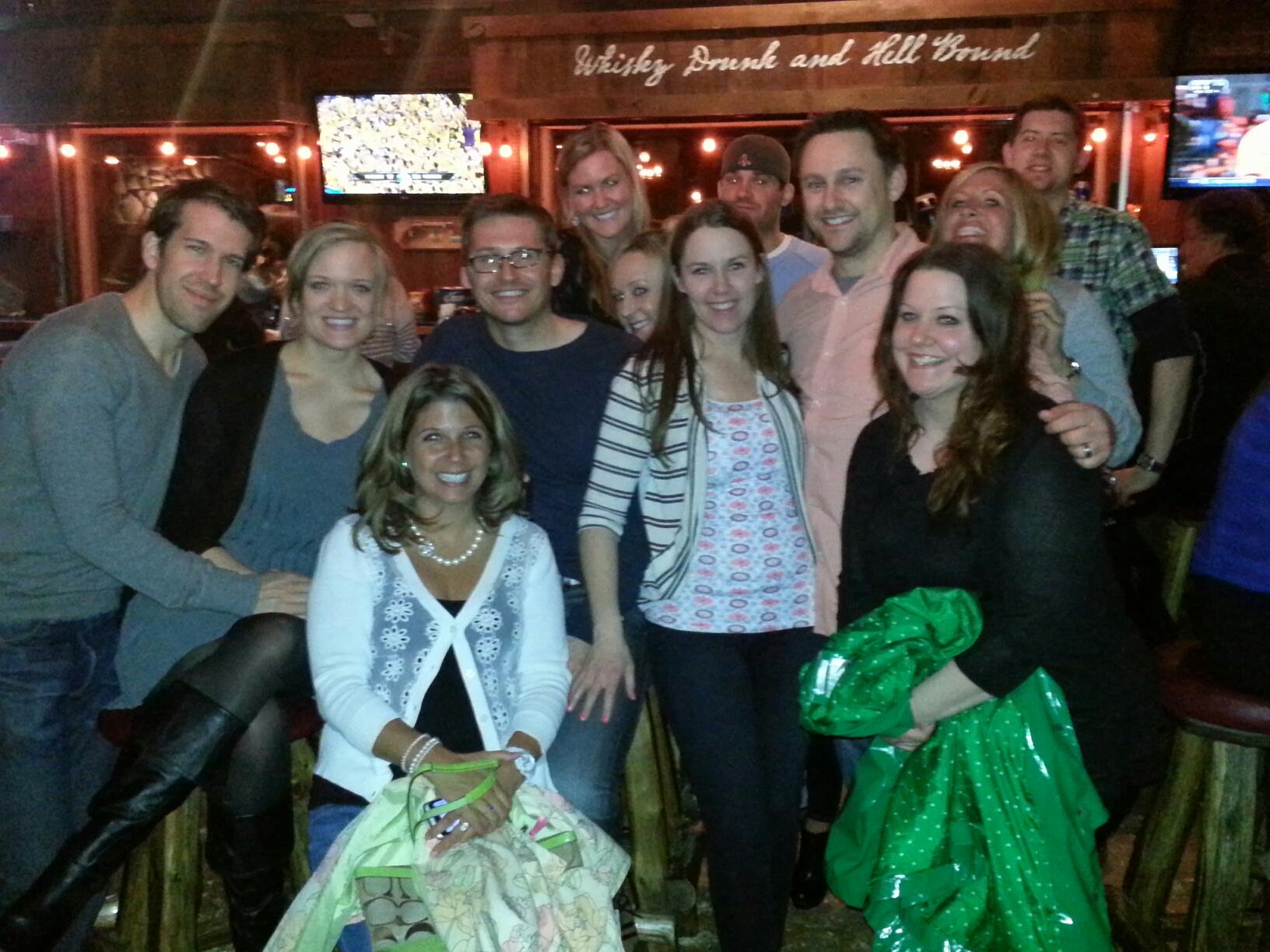
That’s me and my beautiful wife stage right. Behind the photographer would be a mechanical bull.
I just finished revisiting some regex code that begins like this:
preg_match_all('%{\$([^} ]+?)}%u', $template, $templateTags);
and becomes a rather bit more complex after that. I wrote it back in 2008. That aging code was sound but needed some updating; actually, I remember walking through Saint Paul, on my way to workout at St. Thomas (at a gym that no longer exists), puzzling through the right way to do nested parsing of template code. I wanted to be able to write these nice clean templates that this chunk of code would then take a look at and replace with content. What I mean is, if you can keep content apart from presentation, you are afforded a lot of flexibility. So, if in the future webpages are written in a completely different language, or if I want to produce an archival version of the site (say, a printed book) in a different format, then this code is the bridge between raw information (content) and final output (presentation).
So, I took the main engine of this site, and refined a few parts of it, adding useful, explicatory comments so 5 years from now I won’t have to again go “how on earth does this work again?”
I enjoyed the brainteaser of retracing my steps from the past, puzzling through a few knotty bits of parsing and using the experience I have gained since to better traverse arrays and clean up the code in a lot of tiny ways.
I love improving the hidden bits, making them better in ways that no one but me sees. Gives me great satisfaction. Unsurprisingly, that’s the part I like about dentistry, too. The patient neither knows nor cares about the precision of the fit of their crown, but I do, and I want it to be not just good enough, but remarkable.
Took out a really really difficult tooth today. #18 (lower left molar), root canal treated, very broken down. Nothing, and I mean no-thing, above bone. Whoa. Elevated a nice flap because I learned the hard way what happens when you do NOT do that… you end up with tissue that looks like hamburger when you are done, and at this point you start to wonder, seriously, that hackneyed phrase from your oral surgery attendings: “if you treat tissue like that, you’re no different than a butcher”. So, yeah, the tissue in this case was in great shape. Good to see. These roots, though, man. They currrrved into bone, down, and down.
Some good pre-op planning paid off, because we had to go through plans A and B before plan C finally delivered the tooth to the outside world.
My patient was spectacular—they really did well, though. We got them nice and numb, and now that the tooth is out, the area can begin healing back to a healthy residual ridge. I’m always happy to be able to do this for folks, and I hope they are happy to have trouble teeth out.
I was running to my car outside the other day, and I planted my left foot to pivot. That foot was on ice, and completely slid out from under me. One moment I was up and running, and you know the way your brain leaves out the details when something painful happens quickly? The next nanosecond I was down on the ground. I laid there for a little while, thankful I had tugged my left leather & wool mitten on the hand that gave the ground a ringing SLAAAP. Up and running, down and not running.
I’m fine, my hand is fine, and actually I don’t share such an anecdote to provide a slapstick image of limited entertainment. Instead, I think it’s a metaphor for life. Sometimes, you get that “maybe not such a good idea” thought in your head, so you half-expect something unforeseen and equilibrium-demolishing is going to happen. Many other times, you just have no idea anything is going to happen; a human’s prescience is limited not only by available knowledge but also by limited scope of focus.
Our prognostications of future events, then, is poor. So, we do our best to enjoy moments when we are up and running, because there will be times when suddenly we are down and not.
Congressional gun control legislation is falling apart:
I can’t stand that this is what America is; that we trade our children’s lives for the opportunity to purchase items specifically invented for killing. I can’t stand it. It’s pathetic and embarrassing and barbaric.
Ben Goldacre: What doctors don’t know about the drugs they prescribe:
Publication bias affects every field of medicine. About half of all trials, on average, go missing in action, and we know that positive findings are around twice as likely to be published as negative findings.
His description of the situation was a “disaster” is quite accurate. The business of primary journals combined with the business of funding studies, together they are letting us down.
↓ More