Philosophy says you can not have good without evil. Which is to say you have no frame of reference, no true way to define “good” if you don’t have it’s opposite. Now, I haven’t the philosophical experience to discuss good’s definition in terms of evil, but I believe it is related to another universal facet of the human experience: joy’s definition in terms of pain.
I took a calc-based physics class freshman year of undergrad taught by exactly the type of man you would expect to teach physics: someone who lived the life of a scientific intellectual, generally unconcerned with the messiness of expressing feelings and discussing emotions. By a peculiar twist of phrasing of which I can’t recall the specifics, he revealed to the class that his daughter was very sick, dying. The reaction was just as surprising, coming from a group of sleep-deprived youngsters just making it through another Wednesday morning class: a subvocal gasp rippled through the class. And one day, his daughter was gone. We knew no details, and our professor’s words gave us nothing but facts: she had been very sick, and suffered no longer. Though his words revealed little, his affect belied a profound relief. I guess I had expected a deep mourning to overcome him, and instead there was an incredible lightness. Over the course of just a week, he seemed to return to his previous self, quicker to laugh, a far more jocular, humorous man. The suffering had been taken away.
• • •
During a proper workout, there should be stretches of time when you wonder if you can push any longer. A good workout should awaken your survival instinct: can I go 30 more seconds? Do I have 3 more reps? Will my lungs burn up if I breathe any faster? Push, push, push. On television shows such as “The Biggest Loser”, such exertion is driven to dramatic heights and nearly reaches parody. But, there truly is drama in a real workout. Thus, afterwards, as the dramatic arc dictates, you experience joy; wow, I’m standing here and it feels so magnificent. I’m just, standing. I’m breathing at a normal rate. Look at the sun, greet it’s warmth. The suffering has been taken away.
• • •
To those incredibly brave mothers who are able to deliver a baby without an epidural (note that I do not disparage those who must use one for innate, unavoidable, physiologic reasons), there is a protracted period of immense pain. Women athletes have muscle tone and endurance helping them through delivery, but they also have something more; the understanding that there’s another phase after the pain. Pain, pain, pain, push, push, suffering — we place a mother’s delivery in many stories because it is true drama. The enormous dopamine rush that accompanies a successful delivery becomes shockingly potent: not only does mother greet a new life, but she delights in the release from exertion. The bond with baby is made even more powerful when it is combined with such relief. Mom is delivered from suffering.
• • •
If I were to jumble up good/evil and joy/pain, I might say I don’t think pain is good. We do not wish pain on our companions, so that they might heighten their sense of joy. But, there pain is, out in the world, always a part of life. Joy doesn’t always spring directly from it, as in the anecdotes above, but joy pulls into clearer focus, a sculpture coming into sharper relief from the carving of the chisel.
I am realizing that I don’t like stuff. Not in a little way, but in a really big way. Having ATVs or a boat sounds like the most awful thing: gas, insurance paperwork, maintenance records, towing trailers… just… yuck. I love to donate things, throw things away, recycle, get rid of worn clothes, throw out stuff I no longer use, and get rid of broken stuff. See, my brain has a tendency to track everything single thing we own and when we get rid of something, it makes that mental list shorter. That’s partly why I want a document scanner. I have giant boxes of school paperwork (literally like over 40 pounds of school papers) that is valuable but unsearchable. Pounds of organized (paid) bills. If I scan all this, it takes up zero space, I recycle of bunch of papers, and all that information is searchable thanks to the magic of optical character recognition.
When people are grocery shopping with headphones on or when they’re totally absorbed in a text message conversation at the gym, I first thought such behavior simply annoyed me. I thought that these people’s disregard for their surroundings bothered me because it put more of what can only be described as dead weight in my path, forcing me to find a passage around inert obstacles that are unaware and unwilling to acknowledge my presence. Then I realized it wasn’t my forced reroute that troubled me but rather that first part—these folk’s lack of awareness.
The majority of people wearing headphones or lost in their phones in spaces where public, social interactions are de rigueur, these people broadcast a certain energy—one that says I have surveyed you, plebs forming my surroundings, and I find you utterly unworthy of my time or my attention. Let me clarify: for the purposes of this essay, I am altogether unconcerned by the changes to various etiquette, norms, and communication standards wrought by the modern technology and gewgaws with which we cocoon and distract ourselves. This is not a “kids these days” thing. My concern is different: the body is present but the spirit is elsewhere.
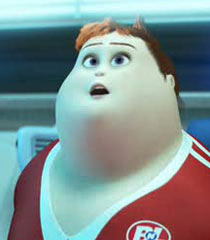
There is a scene in Pixar’s 2008 film Wall·E aboard a giant interstellar cruise ship. Mary, a human who represents the state of humanity, is blithely, completely unaware of her surroundings until a minor accident disables her heads-up communications screen.
She gazes about in astonishment: “I didn’t know we had a pool!” Pixar was not trying to be subtle here, and it’s a testament to the quality of their filmmaking that this scene played neither abrasive nor preachy.
So that’s all I wish, that the engrossed and distracted could realize the beauty, depth, quality, and vitality of what they are missing when they fixate on a tiny screen.
You probably won’t like your first job very much. My first job was at 3M and its only saving grace was that I met a truly great guy named Chris Rupert. Lacking a car, I was taking extremely long bus trips to work and he was nice enough to give me a ride—he’s one of those people who help out, expecting no overblown credit or glory in return. Just a super nice, stand-up guy. I’m lucky to know him. That’s sort of it from that job, though. I’ll be honest, I did a fair amount of sleeping—3M is where I first learned to sleep sitting up. I’d wear my glasses in the morning, and arrive in the empty, recently sold-off Pharm portion of the 3M building. In a nearly-empty farm of cubicles I’d turn on my computer and then… sleep for about an hour. After that I’d go to the bathroom, put in my contacts, and start my day. During the long afternoons, I taught myself object-oriented programming and wrote large chunks of the software behind this website. None of this, not the sleeping, not the programming, was in any way related to my job. But, I learned the ins and outs of corporate email (send a lot of it, be unnecessarily verbose, CC liberally) and the pure, unabashed joy with which folks greeted “free cake in the breakroom.”
Now, I’m coming to the end of another first job, my first job as a dentist. The owner dentist and I agree on, well, nothing. We don’t agree on anything. I practice in an environment that I could never have even imagined. I never ask my assistant to “go get such and such”—instead, I always ask “do we have such and such?” Sometimes, the answer is yes. I have improved at presenting treatment plans, learned some things about setting patient expectations, learned many technical details of doing the job. And yeah, I’m happy to have learned the things I have, but I’m passionate about not doing good or even great dentistry. I want the products, the physical products of my career, the ones people have in their mouths and use every day of their lives, to be remarkable. It’s time for me to seek out an environment where I can continue working toward that goal. That’s the most important lesson I’ve learned working where I have.
So just remember when you start your job, in your career that you’ve picked, you’ll have big expectations. “This is it, time to shine!” You’ll want to see a sign each day that you picked the right thing. At first, you won’t. Expertise and virtuosity aren’t delivered to you ready-made or fully formed. You have to incubate your nascent skills and interests into your future Power Skills. I made up that term, but it is just a shorthand for the fact that I know you are going to be great at whatever you want to be great at. Your dream matters, so don’t ever take difficulties along the way as a sign that you need a different dream. Be careful not to consider a turbulent start as inauspicious.
Just tie up those shoes, gaze ahead to where road meets horizon, choose your path, and start walking.
It’s 0°F outside, parts of the state are getting down into -40°F windchill zone, and our natural gas bill will be a shocker. I’m stretched out on our couch in our living room, wrapped up in literally the most spectacular blanket you could ever have: the Pendleton Glacier Park blanket. I never used to believe there was such a big difference between wool and synthetics, but the warmth underneath wool is just this dry, comforting stupendousness. You don’t sweat, you don’t get overheated. I’m resting my neck, listening to Drew Holcomb & the Neighbors sing What Would I Do Without You.
Looked up at some trees on the way from work to Lifetime today: they cast stark, dark silhouettes against the ruby to blue spectrum of the low winter sunset. And, weirdly, that gets at the reason I love doing my job. I get to take a broken system and try to make it whole. I mercilessly criticize the results of my work everyday, trying to just get better, attempting to return stuff to its unbroken beauty and function. Like trees, like teeth. I’ll be far from here when I’m finally satisfied with my ability to restore something to that beauty and that function.
I have a recurring, very boring nightmare that goes like this: I’m not prepared for something I am about to be graded on. Papers, exams, (actually very few lab practicals or demonstrations of skill… my dream brain must believe I can fake my way through those), tests, quizzes, show-and-tells, finals, blue books—they’re all in there and my dream-self is not prepared. Last night I went to bed a little earlier than usual and got to enjoy something rare: the chance to wake up, realize you are pretty well rested, but notice you have few hours until you must start the day. It is said that you dream all night, but don’t remember your dreams; REM-heavy cycles in the pre-dawn hours are usually something to be savored, since during those you remember your dreams. But I’ve realized something: my brain must give me an exam I’m not ready for every single night, I just don’t usually remember it.
My brain is actually stressing me out while I am trying to rest.
Set aside the positive and practical implications of enforced exposure therapy that dreams offer, and you find a sad truth: the only time in our lives when we can literally make anything happen right before our very eyes, we are bound by the laws of physics and limitations of our realities. In a perverse restriction of the infinite possibility of dreaming, your subconscious realizes that you are imagining something new rather than reassembling something that has been, and pops you out of your dream. Your magnificent dream.
I used to have a dream I could fly. Not that I was subjected to flight, or I had a magnificent vista, no. I dreamed that I was a fully autonomous flying being. In the gray shadows of dreamscape, it always began the same way: I knew it was something I could do. And let me diverge for a second: isn’t that funny that when we are young, optimism leaves us with not only a rosier worldview, but also with a palpable sense of the possible? Why can’t I run the 100M that fast? Why shouldn’t I play that passage, jump that high, change that part of my world? What is this can not? Stultifying pessimism may be the high price of years of experience.
Anyhow, back to my dream: I found myself in a vibrant though colorless world, at the basketball pole of my parent’s home. In the shadowless, heatless midday, I ran a few corkscrews, my feet leaving the ground as I did, the geometry of my path continuing about itself as I rose into the sky. And nothing popped me out of it all. As I soared over hills and through clouds, nothing woke me up. For there was nothing preposterous or improbable about it—life was all possibility and the wind provided no resistance.
Whenever I feel optimistic about human nature, I seem to make the mistake of reading more history:
Mao was also frequently compared to China’s First Emperor
Qin Shi Huang, notorious for burying alive hundreds of
scholars—and liked the comparison. During a speech to
party cadre in 1958, Mao said he had far outdone Qin Shi
Huang in his policy against intellectuals: “He buried 460
scholars alive; we have buried forty-six thousand scholars
alive…You [intellectuals] revile us for being Qin Shi
Huangs. You are wrong. We have surpassed Qin Shi Huang a
hundredfold.”
— Wikipedia, Mao Zedong
A few thousand years ago, if a violent sociopath wanted to foist their ideals on a group, their reach was limited by their relatively small sphere of influence… there simply weren’t a lot of people around. But now, we’ve vaulted into a world where mass communication, tremendous population density, and modern weaponry mean that the consequences of one sociopath can be literally unimaginable. I mean, Mao killed 40-70 million people with his policies, while introducing a system of government where critique of his actions is forbidden to this day. Thus, there is a mismatch between technology and human nature. Outside, our lives are girded by sleek modernity, but inside we remain barbarians.
“Autonomy: the urge to direct our own lives. Mastery: the desire to get better and better at something that matters. Purpose: the yearning to do what we do in the service of something larger than ourselves.”
That’s Dan Pink talking about “The puzzle of motivation”. He points out that scientific studies have consistently shown, regardless of culture, that the more monetary (external, carrot and stick) motivation you use to promote behavior, the less creativity and problem solving you cultivate. If you want creativity and problem solving, you must allow autonomy, mastery, and purpose to flourish (internal motivation).
One of the ways internal motivation is cultivated in a company is “20% time”, where employees can focus on problems and challenges important to them, for 1 out of the 5 days during which they work.
There is a strong tendency, and I think it is a universal one, to want to say the right thing so that we may give solace in the form of a wise statement to a fellow suffering human. I find this compulsion to be particularly strong when confronting death; I always assumed that this was because death was this common endpoint we all share. This is of course true, but I don’t think that’s why we try for these wise phrases. I think, instead, it is the unknowable nature of death that makes us attempt to say something profound. You want to be that person who sighs, swirls their drink, and says the perfect thing. You want to be that for the sufferer, for yourself, but most importantly, for this reason: to be capable of making a wise statement about death would mean you have somehow put a logic fence around it. That you have it surrounded, reined-in, controlled. That you have somehow made the unknowable into something manageable. That the scintillating spotlight of your human brilliance illuminated the blackness, however briefly.
I have since abandoned this compulsion, because instead of the dazzling spotlight, it produces painfully vague generalities and trite statements of the obvious. To simply be in that moment, to let trouble hang in the air between two people, that’s the only thing that helps with the unknowable.