Spring (Snow) Showers
Me: I wonder if this giant snowstorm was Mother Nature’s version of an April Fool’s joke.
Chris: Maybe.
Me: Well if it was, I don’t get it.
Chris: Me neither.
Me: I wonder if this giant snowstorm was Mother Nature’s version of an April Fool’s joke.
Chris: Maybe.
Me: Well if it was, I don’t get it.
Chris: Me neither.
According to Bulletin Today, the UST news source: Brass plumbing pipes stolen from campus restroom last week:
The University of St. Thomas Public Safety Department posted an alert Friday regarding the theft of brass plumbing pipes from men’s restrooms in O’Shaughnessy Educational Center on the St. Paul campus.
The pipes were stolen Wednesday evening, March 26. That same night, pipes were stolen at Macalester College. Pipes in the Murray-Herrick Campus Center restrooms were tampered with, but not removed.
Is brass valuable for reselling or something? I’m lost.
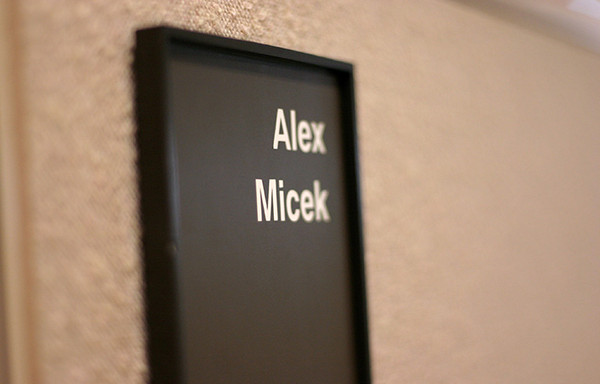
These are magnetic… so I look forward to being able to use this on my fridge.
An interesting architectural guideline: “Light on two sides of every room.” The observation:
When they have a choice, people will always gravitate to those rooms which have light on two sides, and leave the rooms which are lit only from one side unused and empty.
Delving a bit more into the theory:
The importance of this pattern lies partly in the social atmosphere it creates in the room. Rooms lit on two sides, with natural light, create less glare around people and objects; this lets us see things more intricately; and most important, it allows us to read in detail the minute expressions that flash across people’s faces, the motion of their hands… and thereby understand, more clearly, the meaning they are after. The light on two sides allows people to understand each other.
Most of the rooms in the house where I grew up have windows on two sides… which, come to think of it, was a really nice thing. Interesting stuff.
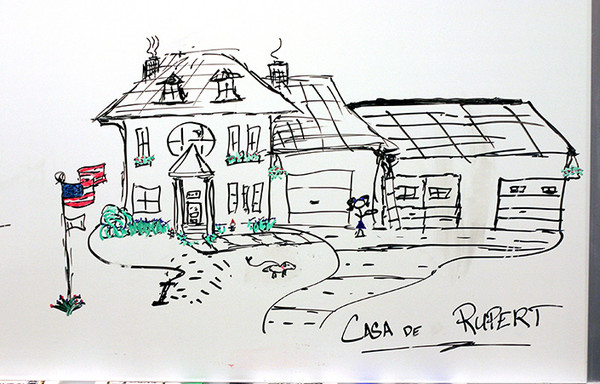
My sketch of my Chris’s future. It has since been revised, but this is the general outline.
Hugh Laurie of House talking to TV Guide — it’s actually a rather good interview considering it’s published in TV Guide, which to the best of my knowledge, isn’t exactly known for insightful journalism (does anyone know otherwise?). Anyhow, Laurie, when asked if he hangs out with celebrities:
I have such a strong aversion to the ubiquitous digital camera that I can’t really bear to go anywhere. It’s pathetic. Not that I am ideal paparazzi fodder—I’m definitely not— but these days you don’t have to be to have your soul chopped up and laid out on the butcher’s slab. So instead I just sit at home and stare at the wall. Which luckily has a huge plasma TV on it.
When asked about exercise:
I run 6-8 miles a day, plus weights and aerobics in the lunch hour. I also lie a lot, which keeps me thin.
Ah… to have the gift of comedy.

This fresh bread made the most amazing peanut butter and jelly sandwiches ever!
Common sense and a little physics seem to show that the radio waves from Wi-Fi internet connections (non-ionising as they are) are nothing to be concerned about:
A typical UK resident receives far more radiation from analogue radio broadcasts than they do from Wi-Fi. Radio broadcasts have operated in the UK for almost 85 years, so if we’ve not heard of any long term negative health effects caused by radio waves so far, it’s unlikely that we will do in the future.
I have a hard time thinking cell phone waves are anything other than harmless, as well. Remember, not all radiation is created equal — so don’t let people try to confuse you by conflating radiation from one source with something like radiation from the sun, or a microwave.
I don’t know if this is true or not, but a farmer in the UK who directed his sheepdogs for three hours to spell out the word ‘spring’ on the side of a hill, is a difficult story to make up. Anyhow, the pictures look amazing. Collies sure are neat dogs.
↓ More