My 84-year-old patient was nearing the end of another denture fitting appointment, and he had just accidentally spilled all of his water on the operatory floor. “No no,” I said, “you’re doing just fine.” Trying to reassure him, I couldn’t think of anything better to say.
At the time, I didn’t realize that I was not going to see my patient again. Shortly after that appointment, I was informed that he had to be transferred to hospice and would be unable to make any future appointments at the school. Still, a few months later, his words come to me every few days, reminding me of something important.
Biking along the Greenway today, my wife and I were happy: we will soon celebrate two years of marriage, we have years of happiness ahead, and are excited about the unpredictable nature of life. Like a path strewn with riches I don’t yet know of, my life winds away in front of me.
I’m just old enough to know I should enjoy what youth I still have.
I’m young enough to be able to execute.
But there’s still this poison that creeps in: as we biked along, I’m getting upset about something at school, or upset that there’s something in my eye, or angry that I didn’t pack sunscreen. The point is: loss of perspective is poison. It yanks you out of the experiential and into the narrative. And it happens to me with shameful frequency. Sometimes, not always, but sometimes, my patient’s words crash through my shortsightedness: “I’m not doing so well.”
Alex, here you are, doing great. But you think there’s something wrong. You’ve got years ahead, but you’re stuck dwelling on short-term minutiae. You’ve got your health, but obsess over the jog you didn’t take. Inevitably, when I recall my patient’s words, I feel a sense of guilt. Somewhere, in a quiet room, my patient is sitting. He can’t do the things I can. His best years are behind him. He has family, but more often than not they’re elsewhere. He told me getting married was the best thing he ever did, but now his wife is gone.
Yet, I have the audacity to get upset over something in my eye.
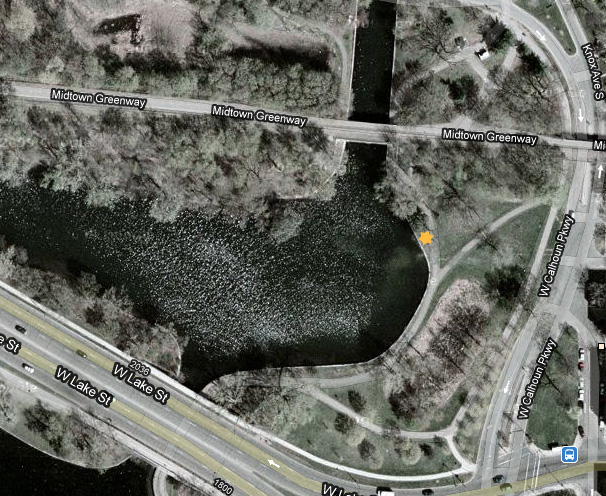
We biked the Midtown Greenway today: headed over to Lake Calhoun and enjoyed the shops and biking. On the southwest side of the lake, there was a group of college kids that had set up a giant slip ‘n slide. We stopped and joined the spectators. One lady: “I couldn’t figure out why that girl was covered in soap!”
On our way back, we stopped at the connection between Lake Calhoun and Lake of the Isles, which turns 100 in two days. The plaque on the path there said that 100,000 people celebrated the joining of the two lakes, that celebrations last for a week, that the lakes were filled with whimsical floats, and that a symphony from New York came in to perform a march written expressly for the occasion.
This obituary for Huguette Clark, who recently died at the age of 104, may be one of the oddest I’ve ever read.
For the quarter-century that followed, Mrs. Clark lived
in the apartment in near solitude, amid a profusion of
dollhouses and their occupants. She ate austere lunches
of crackers and sardines and watched television, most
avidly “The Flintstones.” A housekeeper kept the dolls’
dresses impeccably ironed.
Odd, right? Take into further account that she had multiple estates around the country and lived most of her life on Fifth Avenue in New York.
Oh, and she was worth over 400 million dollars.
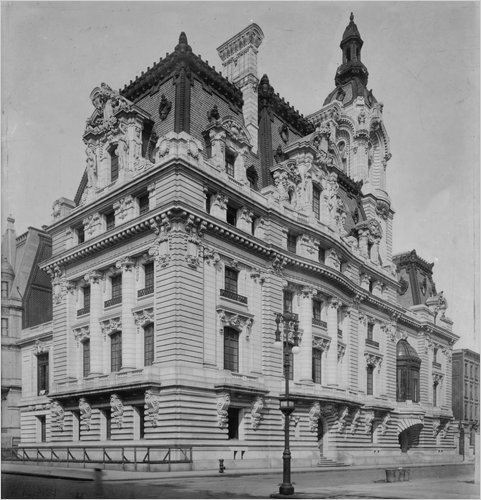
Her father was William A. Clark, a copper baron born in the 1800s. He built an absolutely astounding 121 bedroom mansion on Fifth Avenue. Here’s a picture, courtesy of the New York Times:
It was, in a stupendous act of stupidity and greed, knocked down in 1926 when restrictions on building height were lifted. Carter B. Horsley:
“No loss was viewed in retrospect to have been greater
than that of Senator William Clark’s 121-room pile at
Seventy-seventh Street, which was felled by the wrecker’s
ball in 1926,” wrote Robert A. M. Stern, Gregory Gilmartin
and Thomas Mellins in their book, “New York 1930,
Architecture and Urbanism Between the Two World Wars,”
(Rizzoli, 1988).
“Yet at the time only The New York Times appeared moved:
‘As for the Clark palace, it has been condemned
unreasonably, indiscriminately. An echo of the
architectural orgy of the Paris Exposition of 1900, its
only fault is that it stops short of perfection in its
kind. The inlaid gold leaf that decks its interior
woodwork should have been spread upon its fantastic
stonework without. Its astronomical tower should have been
surmounted by an orrery with a sun of flame and planets of
solid gold. It might thus have truly exemplified the
senatorial mood of the eighteen-nineties, illumined by the
ambitions of a doge.’
That was this woman’s home, for a time. With her, the last living memory of that house, that era, is gone. How small our scratches and turrets on the earth seem after time’s erosion.
My wife just made the most wonderful veggie burger on toasted sandwich thin for lunch. The secret? An awesome veggie burger (do you remember which brand, Mykala?) and smoked gouda. Wow. Happy grilling season, minus the grilling and minus the meat.
This great talk, in which James H Kunstler dissects suburbia, articulates an important problem. We’ve built “places that aren’t worth caring about” that are only accessible via giant highways powered by cars running on temporarily cheap oil. So, when you take the long view (which isn’t very long at this point), you’ll find that suburbs can’t continue as they are. People do not thrive in the isolation of suburbs:
But what happens is, of course, it mutates over the next
80 years and it turns into something rather insidious. It
becomes a cartoon of a country house, in a cartoon of the
country. And that’s the great non-articulated agony of
suburbia, and one of the reasons that it lends itself to
ridicule. Because it hasn’t delivered what it’s been
promising for half a century now.
Some lady gave me the finger this morning. I was three houses down the street, on my bike as I always am, when my path crossed orthogonally to a Ford Taurus (or Honda Accord… I don’t recall because I was trying to review Tylenol dosing in my head as a last-minute preparation for my morning Clinical Pharm exam). Nothing seemed odd about that, and I continued down Warwick, taking the lane. Apparently, the lady behind me was lost.
And angry.
And gesture-y.
HOOOOONK.
I turned to my right, in time to see this middle-aged lady really angrily holding up her middle finger at me. She looked kind of like a mischievous leprechaun that had a really tiny hand. I immediately started laughing.
Mykala just made kushari. Ours was brown lentils, elbow noodles, rice, tomato purée + spices, and very well-caramelized onions. It was EXTREMELY good: according to Wikipedia and Anthony Bourdain, it is a staple dish in many parts of the Middle East. Someday, we’ll visit that part of the world and try this — until then, we’ll stick with a taste-bud trip.
The way of nature or the way of grace - you have to choose which one you will follow.
This binary view is interesting, because it becomes thus: you can do either this or that. You can not do both. You can not do neither. You have to pick. Embracing one, you distance yourself from the other. It’s simple in theory, difficult in practice.
You can experience the world through your narrative
circuitry, which will be useful for planning, goal
setting, and strategizing. You can also experience the
world more directly, which enables more sensory
information to be perceived. Experiencing the world
through the direct experience network allows you to get
closer to the reality of any event. You perceive more
information about events occurring around you, as well as
more accurate information about these events. Noticing
more real-time information makes you more flexible in how
you respond to the world. You also become less imprisoned
by the past, your habits, expectations or assumptions,
and more able to respond to events as they unfold.
The narrative is our default. We are planning, telling ourselves the story of ourselves, thinking ahead, rehashing. We do this all the time. When we pause this activity, we get to experience the full immersive power of the stream of sensory information coming at us. This makes us experience life more richly. The platitude “live in the moment” isn’t about neglecting to plan, it’s about choosing to really be here, so you get the most out of right now.
It’s thundering right now. I’m sick as heck, and Mykala just got back for the evening. She was kind enough to make me an absolutely delicious late dinner.
Today, a doctor was extremely disappointed with what I had done with my crown preparation. Their exact words: “What were you thinking?” I did not appreciate hearing this, nor did I appreciate the way they had handled the entire appointment. I wanted to say this to the doctor: “Look, there are two possibilities. Either I messed this up on purpose, just to bother you. OR, I am still learning, and had I had a little more guidance, I’m sure the final product would have been well within your range of ideal. Now give me a break.”
However, doctors have the power to ruin us while we are still only students. So, I never ever critique a doctor to their face. Ever. I always tell them what they want to hear, and will continue to withhold until I’m licensed and practicing. There’s just too much debt to risk not graduating because a doctor got offended.
So, here’s what I said: “I don’t know what I was thinking. I’m sorry. Thank you so much for your help today!”
That, my friends, is why I never tell anyone in person about this website. It is also why, when you search my name in Google, you will not find this space.