Mini Burritos
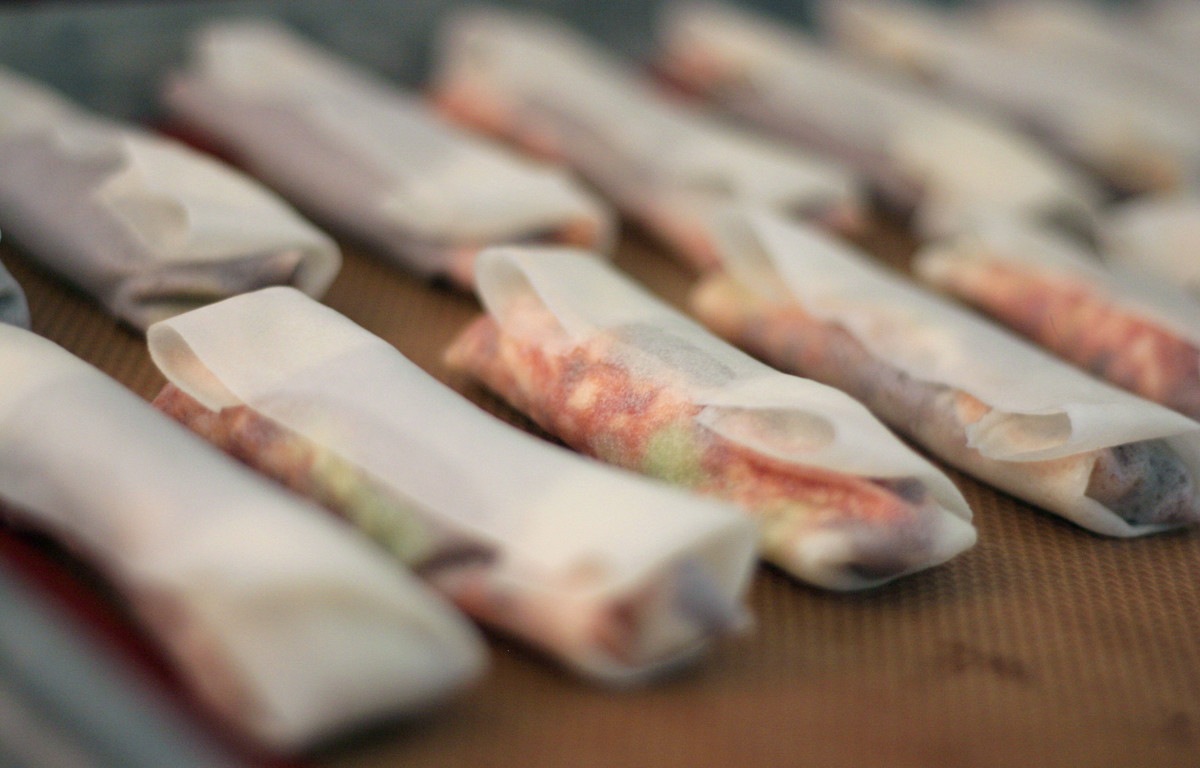
They were delicious, vegan, and contained burrito things.
They were delicious, vegan, and contained burrito things.
It’s 0°F outside, parts of the state are getting down into -40°F windchill zone, and our natural gas bill will be a shocker. I’m stretched out on our couch in our living room, wrapped up in literally the most spectacular blanket you could ever have: the Pendleton Glacier Park blanket. I never used to believe there was such a big difference between wool and synthetics, but the warmth underneath wool is just this dry, comforting stupendousness. You don’t sweat, you don’t get overheated. I’m resting my neck, listening to Drew Holcomb & the Neighbors sing What Would I Do Without You.
Looked up at some trees on the way from work to Lifetime today: they cast stark, dark silhouettes against the ruby to blue spectrum of the low winter sunset. And, weirdly, that gets at the reason I love doing my job. I get to take a broken system and try to make it whole. I mercilessly criticize the results of my work everyday, trying to just get better, attempting to return stuff to its unbroken beauty and function. Like trees, like teeth. I’ll be far from here when I’m finally satisfied with my ability to restore something to that beauty and that function.
I have a recurring, very boring nightmare that goes like this: I’m not prepared for something I am about to be graded on. Papers, exams, (actually very few lab practicals or demonstrations of skill… my dream brain must believe I can fake my way through those), tests, quizzes, show-and-tells, finals, blue books—they’re all in there and my dream-self is not prepared. Last night I went to bed a little earlier than usual and got to enjoy something rare: the chance to wake up, realize you are pretty well rested, but notice you have few hours until you must start the day. It is said that you dream all night, but don’t remember your dreams; REM-heavy cycles in the pre-dawn hours are usually something to be savored, since during those you remember your dreams. But I’ve realized something: my brain must give me an exam I’m not ready for every single night, I just don’t usually remember it.
My brain is actually stressing me out while I am trying to rest.
Set aside the positive and practical implications of enforced exposure therapy that dreams offer, and you find a sad truth: the only time in our lives when we can literally make anything happen right before our very eyes, we are bound by the laws of physics and limitations of our realities. In a perverse restriction of the infinite possibility of dreaming, your subconscious realizes that you are imagining something new rather than reassembling something that has been, and pops you out of your dream. Your magnificent dream.
I used to have a dream I could fly. Not that I was subjected to flight, or I had a magnificent vista, no. I dreamed that I was a fully autonomous flying being. In the gray shadows of dreamscape, it always began the same way: I knew it was something I could do. And let me diverge for a second: isn’t that funny that when we are young, optimism leaves us with not only a rosier worldview, but also with a palpable sense of the possible? Why can’t I run the 100M that fast? Why shouldn’t I play that passage, jump that high, change that part of my world? What is this can not? Stultifying pessimism may be the high price of years of experience.
Anyhow, back to my dream: I found myself in a vibrant though colorless world, at the basketball pole of my parent’s home. In the shadowless, heatless midday, I ran a few corkscrews, my feet leaving the ground as I did, the geometry of my path continuing about itself as I rose into the sky. And nothing popped me out of it all. As I soared over hills and through clouds, nothing woke me up. For there was nothing preposterous or improbable about it—life was all possibility and the wind provided no resistance.
Whenever I feel optimistic about human nature, I seem to make the mistake of reading more history:
Mao was also frequently compared to China’s First Emperor Qin Shi Huang, notorious for burying alive hundreds of scholars—and liked the comparison. During a speech to party cadre in 1958, Mao said he had far outdone Qin Shi Huang in his policy against intellectuals: “He buried 460 scholars alive; we have buried forty-six thousand scholars alive…You [intellectuals] revile us for being Qin Shi Huangs. You are wrong. We have surpassed Qin Shi Huang a hundredfold.”
— Wikipedia, Mao Zedong
A few thousand years ago, if a violent sociopath wanted to foist their ideals on a group, their reach was limited by their relatively small sphere of influence… there simply weren’t a lot of people around. But now, we’ve vaulted into a world where mass communication, tremendous population density, and modern weaponry mean that the consequences of one sociopath can be literally unimaginable. I mean, Mao killed 40-70 million people with his policies, while introducing a system of government where critique of his actions is forbidden to this day. Thus, there is a mismatch between technology and human nature. Outside, our lives are girded by sleek modernity, but inside we remain barbarians.
“Autonomy: the urge to direct our own lives.
Mastery: the desire to get better and better at something that matters.
Purpose: the yearning to do what we do in the service of something larger than ourselves.”
That’s Dan Pink talking about “The puzzle of motivation”. He points out that scientific studies have consistently shown, regardless of culture, that the more monetary (external, carrot and stick) motivation you use to promote behavior, the less creativity and problem solving you cultivate. If you want creativity and problem solving, you must allow autonomy, mastery, and purpose to flourish (internal motivation).
One of the ways internal motivation is cultivated in a company is “20% time”, where employees can focus on problems and challenges important to them, for 1 out of the 5 days during which they work.
There is a strong tendency, and I think it is a universal one, to want to say the right thing so that we may give solace in the form of a wise statement to a fellow suffering human. I find this compulsion to be particularly strong when confronting death; I always assumed that this was because death was this common endpoint we all share. This is of course true, but I don’t think that’s why we try for these wise phrases. I think, instead, it is the unknowable nature of death that makes us attempt to say something profound. You want to be that person who sighs, swirls their drink, and says the perfect thing. You want to be that for the sufferer, for yourself, but most importantly, for this reason: to be capable of making a wise statement about death would mean you have somehow put a logic fence around it. That you have it surrounded, reined-in, controlled. That you have somehow made the unknowable into something manageable. That the scintillating spotlight of your human brilliance illuminated the blackness, however briefly.
I have since abandoned this compulsion, because instead of the dazzling spotlight, it produces painfully vague generalities and trite statements of the obvious. To simply be in that moment, to let trouble hang in the air between two people, that’s the only thing that helps with the unknowable.
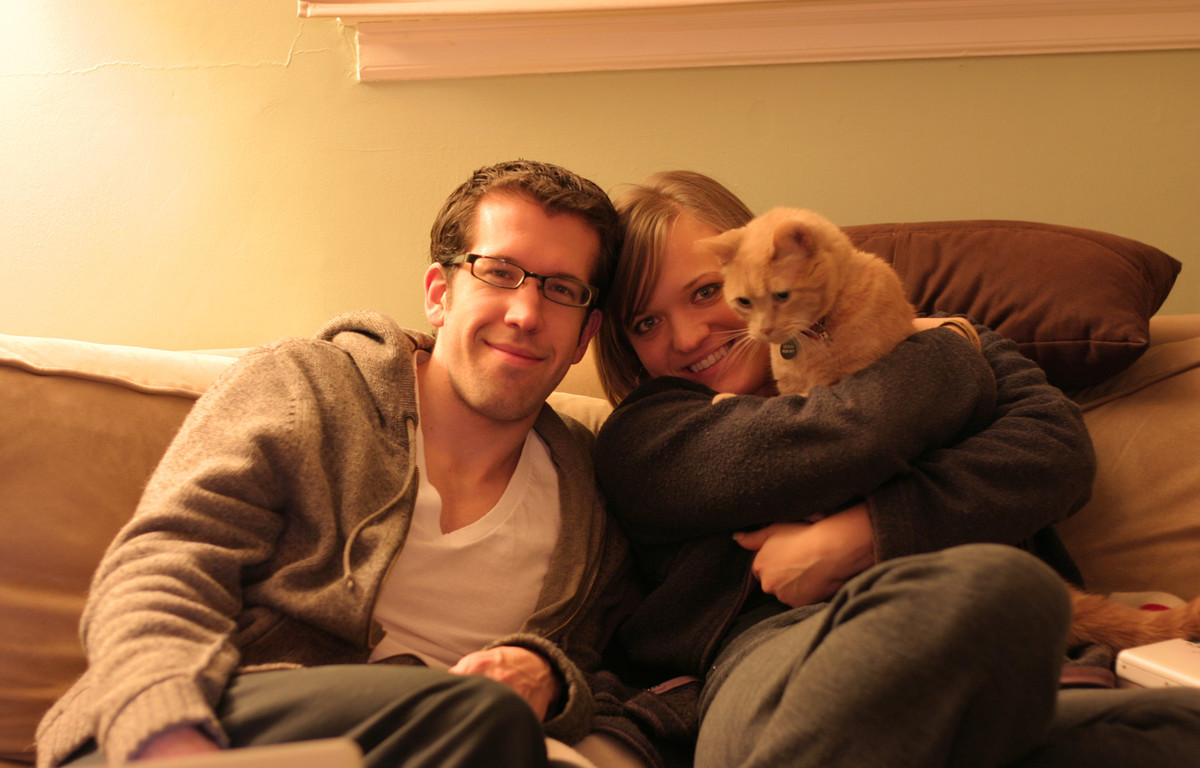
This is my favorite part of a cold winter day: sharing some time on our couch together, just the three of us. These little things make up our lives, and I cherish this part of each day.
↓ More