During the credit boom of 2005 to 2007, profits and pay
reached unprecedented highs. It is now evident that the
bankers were being rewarded largely for taking on
unacknowledged risks: after the subprime market collapsed,
bank shareholders and taxpayers were left to pick up the
losses. From an economy-wide perspective, this experience
suggests that at least some of the profits that Wall
Street bankers claim to generate, and that they use to
justify their big pay packages, are illusory.
At the end of his piece, Cassidy links the stagnation of the middle class, which accelerated in the 1980s, to the simultaneous rise of giant Wall Street investment banking houses, derivatives traders, etc. I don’t think this causation hypothesis is entirely inaccurate, but I would instead emphasize Cassidy’s idea of a lack of societal contribution — as evidenced but he title, that’s the best take-away from the article.
So, what is the deal with the stagnation of the middle class? Krugman would attribute it to the loss of “strong unions, a high minimum wage, and … progressive tax system” that produced a broader distribution of wealth in the 40s and was dismantled in the 80s. I don’t disagree, but I think a force more powerful than government policies underlies the stagnation.
Certainly, the general declining trend of the US since the 1980s (punctuated by bubbles, growth, busts) is extraordinarily multifactorial, but I think Gladwell’s The Risk Pool points to an extremely important, always overlooked factor: our aging population.
This relation between the number of people who aren’t of
working age and the number of people who are is captured
in the dependency ratio.
…
Demographers estimate
that declines in dependency ratios are responsible for
about a third of the East Asian economic miracle of the
postwar era; this is a part of the world that, in the
course of twenty-five years, saw its dependency ratio
decline thirty-five per cent.
The more people you have working to support those who can’t, the more resources you have left over to grow. As our nation grows older and lives longer, our dependency ratio rises, and our working population must first support the growing ranks of the dependent before it can put resources towards growing our economy.
To my future children: I used to own this. Not this exact Trapper Keeper, but this exact design. The title of this Trapper Keeper is “Designer Space”. This is ironic, because this is supremely ugly. Yes, your father used to have amazing taste.
I am exhausted. Hot, too. Thankfully today is much cooler, but a few days back it was the hottest day ever recorded in Minnesota. Of course, there are certain factors regarding the weather station calling the official numbers into question, but here’s what we’ve got:
The dew point sensor at Moorhead spiked to
88 degrees at 7pm Tuesday evening. That’s the highest dew
point ever recorded in Minnesota. (Previous record was/is 86
degrees).
When you combine the air temperature of 93 at that hour,
the heat index calculates out to a Persian Gulf level of
130 degrees! That would also be the highest heat index
ever recorded in Minnesota. (Previously 124 degrees
at Moorhead in 1966)
HERE IS A LISTING OF THE MAXIMUM
HEAT INDEX VALUES CALCULATED FROM
THE TEMPERATURE AND DEW POINT
REPORTED BY AUTOMATED SENSORS
ACROSS CENTRAL AND SOUTHERN
MINNESOTA AND WEST CENTRAL
WISCONSIN.
MINNEAPOLIS ASOS (836 FT)(ASOS)    353 PM    JUL 19    119 F
Anyhow, it has been HOT. Mykala and I both took turns going a little bit crazy on different days — the heat went to our heads.
So, here I sit at our office desk, with the fan blowing directly at me, trying to cram some information into my head for my last standard exam of school.
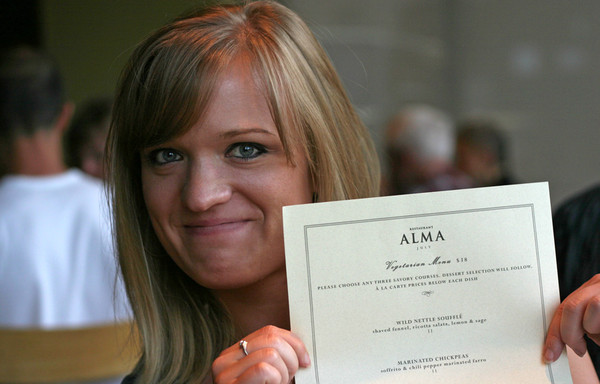
This is us during our 2-day-prior to our 2-year-anniversary celebratory dinner out. It was an absolute blast. We savored and shared our way through a delicious 4 course vegetarian flavor fest at a tremendous Minneapolis restaurant called Restaurant Alma.
I’ve been thinking about the movie Tree of Life, and I haven’t really gotten anywhere. A nice, attempted partial explication of the themes was written by Matt Zoller Seitz, but take a look at this quote:
Why is there a creation sequence? What does it mean?
It’s probably in there because Malick has been imagining
the creation of the universe since he was a boy, and
always wanted to see it depicted on a big screen.
This bothers me a little bit. Basically, Malick gets to produce this entire rambling piece that Seitz describes as a puzzle with no box art. Malick doesn’t do interviews. We don’t know what Malick truly intended. So, we have to place an enormous amount of trust in Malick, that he actually does have an overarching artistic vision.
What if he doesn’t?
If there’s no strict vision, then Malick gets to just toss in scenes of whatever he wants, whenever he wants to. The viewers and critics are forced to do intellectual backflips to connect dots that might not have even been meant to be connected.
I think I trust Malick, but I don’t really have any reason to do so. I’m not sure if all the dots are worth connecting.