The milk is turning to slush in the fridge, which is odd, because the kitchen itself has been over 80°F for the majority of the day. Is the cause high humidity? Mykala has been pounding through a tremendous amount of end-of-semester work, and is currently right in the middle of another paper. Her perseverance amazes me. I can’t offer her much, other than moral support and shoulder massages. And (apparently) very cold milk.
The Wilson Quarterly: America: Land of Loners? by Daniel Akst (via HN) describes the value of friendship, and the modern American man’s increasing refusal to maintain friendships. (Sidenote: I’m getting really sick of question-mark-titles. You either believe whole-heartedly in what you are writing and you are setting out to support it, or you are debunking a myth. You can’t launch a very effective piece of writing by saying “hey, maybe we could think this!”) This friendship-abondoning really made me feel rather sad because I’ve done a horse crap job of maintaining my friendships. I’m looking to improve that, salvage what I have left. Anyhow, on the whole, we don’t have people to talk to:
While most of us wouldn’t last long outside the intricate
web of interdependence that supplies all our physical
needs—imagine no electricity, money, or sewers—we’ve come
to demand of ourselves truly radical levels of emotional
self-sufficiency. In America today, half of adults are
unmarried, and more than a quarter live alone. As Robert
Putnam showed in his 2000 book Bowling Alone, civic
involvement and private associations were on the wane at
the end of the 20th century. Several years later, social
scientists made headlines with a survey showing that
Americans had a third fewer nonfamily confidants than two
decades earlier. A quarter of us had no such confidants at
all.
Here’s one I love: the “conspicuous busyness” idea from Barbara Ehrenreich (she wrote Nickel and Dimed):
Developing meaningful friendships—having the kind of
people in your life who were once known as
“intimates”—takes time, but too many of us are locked in
what social critic Barbara Ehrenreich has called “the cult
of conspicuous busyness,” from which we seem to derive
status and a certain perverse comfort even as it alienates
us from one another.
Now, while I have been truly busy in the past few years, I’ll be fooling myself to say that in the next two years I’ll be too busy for friends. Two points:
FRIENDSHIPTHEORYOFBADTIMING: We consider ourselves too busy for friends right when we need them most.
FRIENDSHIPTHEORYOFTIMEMANAGEMENT: We grow in our value to others when we learn how to help them while still maintaining our own lives.
When I posted that recent update Regrets of the Dying, one of those recurring regrets went thusly: “I wish I had stayed in touch with my friends.”
People avoid discussing religion or politics in polite company because those discussions cut through all the layers of pretense in which we shroud ourselves. These two topics, one focused on the divine and the other on the human, throw open the windows and shutters of a person’s mental house, allowing all the neighbors to scrutinize another’s deepest secrets, thoughts and prejudices. So, religion and politics are a wonderful way to quickly understand a person’s true character. My understanding is that this is not the purpose of polite conversation.
Roy F. Baumeister asks Is There Anything Good About Men? (Via HN.) He begins with this wonderfully interesting idea: biological differences result in a different payoff for risk-taking behavior. For men, taking risks, striving, fighting other men can payoff brilliantly in terms of reproductive success, but the same actions don’t help women much:
Experts estimate Genghis Khan had several hundred and
perhaps more than a thousand children. He took big risks
and eventually conquered most of the known world. For him,
the big risks led to huge payoffs in offspring. My point
is that no woman, even if she conquered twice as much
territory as Genghis Khan, could have had a thousand
children. Striving for greatness in that sense offered the
human female no such biological payoff. For the man, the
possibility was there, and so the blood of Genghis Khan
runs through a large segment of today’s human population.
By definition, only a few men can achieve greatness, but
for the few men who do, the gains have been real. And we
are descended from those great men much more than from
other men. Remember, most of the mediocre men left no
descendants at all.
What we have here is a very thoughtful, scientifically rigorous piece on the difference between men and women. Baumeister asserts that men and women have the same abilities but different interests. That is, the intellectual capacity to do challenging tasks is present in equal measure in men and women, but due to different evolutionary strategies, pressures, and physiologic capabilities (partly described above), men and women choose different paths to navigate their interpersonal relationships and society as a whole:
The conclusion is that men and women are both social but
in different ways. Women specialize in the narrow sphere
of intimate relationships. Men specialize in the larger
group. If you make a list of activities that are done in
large groups, you are likely to have a list of things that
men do and enjoy more than women: team sports, politics,
large corporations, economic networks, and so forth.
The narrow sphere versus larger group has big consequences:
Cross and Madsen covered plenty of research showing that
men think of themselves based on their unusual traits that
set them apart from others, while women’s self-concepts
feature things that connect them to others. Cross and
Madsen thought that this was because men wanted to be
apart from others. But in fact being different is vital
strategy for belonging to a large group. If you’re the
only group member who can kill an antelope or find water
or talk to the gods or kick a field goal, the group can’t
afford to get rid of you.
It’s different in a one-to-one
relationship. A woman’s husband, and her baby, will love
her even if she doesn’t play the trombone. So cultivating
a unique skill isn’t essential for her. But playing the
trombone is a way to get into some groups, especially
brass bands. This is another reason that men go to
extremes more than women. Large groups foster the need to
establish something different and special about yourself.
So, whither all these hyper-competitive, differentiation-seeking, glory-oriented men? From an reproductive perspective, men are more expendable than women:
If a group loses half its men, the next generation can
still be full-sized. But if it loses half its women, the
size of the next generation will be severely curtailed.
Hence most cultures keep their women out of harm’s way
while using men for risky jobs.
And, you can even scale these species-oriented sociological conclusions back down to psychological conclusions:
All-male groups tend to be marked by putdowns and other
practices that remind everybody that there is NOT enough
respect to go around, because this awareness motivates
each man to try harder to earn respect. This,
incidentally, has probably been a major source of friction
as women have moved into the workplace, and organizations
have had to shift toward policies that everyone is
entitled to respect. The men hadn’t originally built them
to respect everybody.
So, I quote extensively not only to lead myself back through Baumeister’s thought process, but to save these ideas for posterity (links tend to go dead in this ephemeral online world). Anyhow, these are interesting ideas: men and women are much more different in their goals and interests than in their abilities.
How extreme should your first offer be? My own research
suggests that first offers should be quite aggressive but
not absurdly so. Many negotiators fear that an aggressive
first offer will scare or annoy the other side and
perhaps even cause him to walk away in disgust. However,
research shows that this fear is typically exaggerated.
In fact, most negotiators make first offers that are not
aggressive enough.
Good to keep in mind for future dental negotiating.
The “Regrets of the Dying” have quite a bit of overlap. Let us learn from them now, early, in this lovely piece by Bronnie Ware:
I wish I’d had the courage to live a life true to myself, not the life others expected of me.
I wish I didn’t work so hard.
I wish I’d had the courage to express my feelings.
I wish I had stayed in touch with my friends.
I wish that I had let myself be happier.
The hardest thing about reading these is not comprehending them — they’re common, to the point of platitude. However, it’s keeping them in mind such that they guide your life and your decisions that is the true challenge.
My wife, Mykala. She packed some AMAZING food for the trip, and we’ve been eating that for most of our meals, making this adventure just as affordable as it is fun.
Top Thill Dragster at Cedar Point. Imagine going from 0-120 miles per hour in 3.8 seconds, then immediately climbing to the top of a 42 story tower.
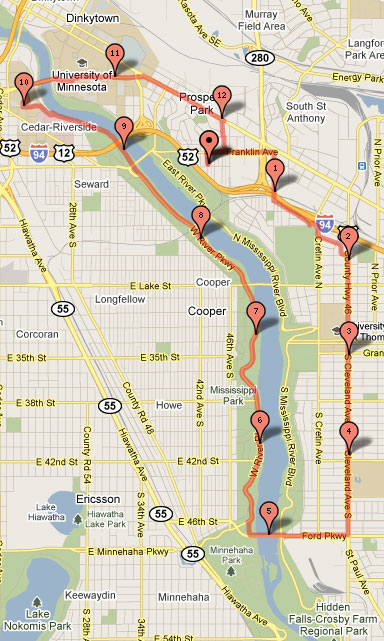
I rode the West River Parkway up from the St. Paul Lifetime via Ford Parkway and WOW what a path! Darn thing is practically level for a few miles and smoother than an ice rink that’s just been Zambonied. More grip than ice, though.
If you’re looking for a nice easy bike ride in Minneapolis, you’d be hard-pressed to find a better path than the West River Parkway. However, it isn’t all… flat. North of Franklin, it drops off toward the river in about the most giant hill you can find. So, there’s that.
Every one of those worlds is lovely and instructive. But,
so far as we know, every one of them: desolate and barren.
Out there, there are no better places—so far, at least.
One of Sagan’s best is The Pale Blue Dot. I wish they showed that to everybody in school.