Here’s a quick physics idea: compression forces can be modeled as tension forces. And that’s exactly what Gaudí did in order to get the angles of his fantastic arches correct.
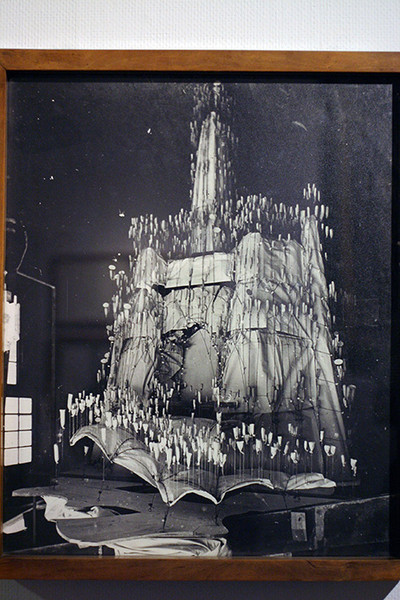
Take a close look at what’s going on here — this is a photograph that has been turned upside down.
What Gaudí did was connect chains in the pattern he wanted for his arches. Then, he attached small bags of lead shot to the lowest ends of the chains, putting tension on them. The resulting angles and proportions that Gaudí’s simulation produced meant he could flip the photo upside down, trace it, and get a stunningly accurate (and stable!) blueprint for the desired structure.
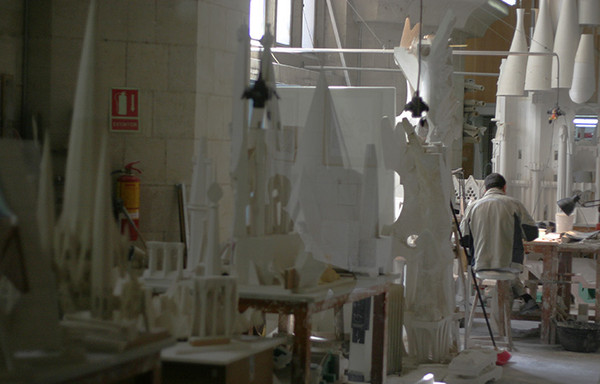
Here’s one the most amazing parts of the whole tour: the cathedral is still under construction, so a small cadre of artists and craftsmen continue their work under the eyes of tourists. One critical component of Gaudí’s method was the use of plaster models — this workshop continues to produce those models so construction can continue.
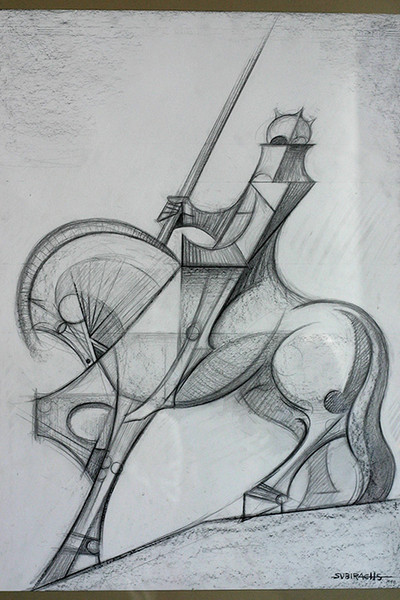
Gaudí obsessed over this cathedral, and realizing it would never come close to completion during his time, labored with absolute dedication in the latter part of his life to drawing up plans, models, and details so that work could continue long after his death. Unfortunately, most of his work was destroyed during the revolution, but was painstakingly pieced together again when the political climate stabilized. These reconstructed plans direct the construction today.
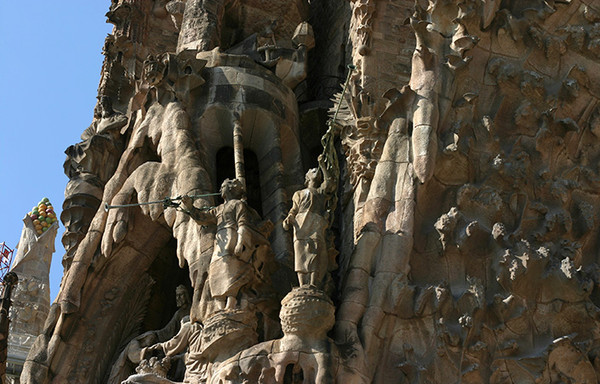
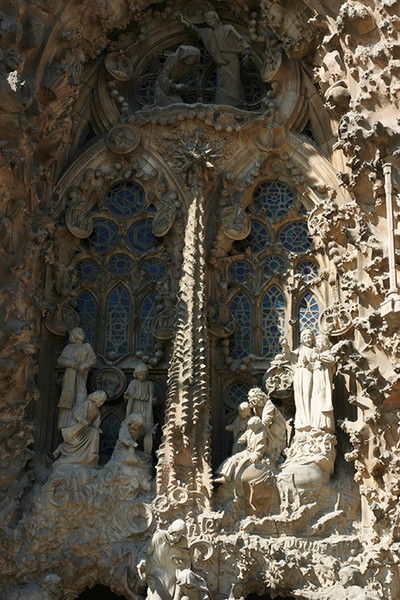
This is the older end of the cathedral, completed while Gaudí was still alive. The stonework simultaneously evokes the heavy Gothic style and yet the proportions and naturalistic bent of the decorations also pull in the Catalan Modernisme movement.