Conan O’Brien’s commencement address at Harvard makes a pretty quick read and an excellent examination of fantastic comedy writing. In addition to functioning on the levels of entertainment and humor, the speech goes a step further: it actually inspires. This line between laughter and inspiration is particularly difficult to walk in public speaking, but Conan did so quite successfully here. I’d highly recommend reading the entire speech, but here’s my favorite part, in which Conan speaks about starting up [Late Night with Conan O’Brien] in 1993.
So, this was undeniably the it: the truly life-altering break I had always dreamed of. And, I went to work. I gathered all my funny friends and poured all my years of comedy experience into building that show over the summer, gathering the talent and figuring out the sensibility. We debuted on September 13, 1993 and I was happy with our effort. I felt like I had seized the moment and put my very best foot forward. And this is what the most respected and widely read television critic, Tom Shales, wrote in the Washington Post: “O’Brien is a living collage of annoying nervous habits. He giggles and titters, jiggles about and fiddles with his cuffs. He had dark, beady little eyes like a rabbit. He’s one of the whitest white men ever. O’Brien is a switch on the guest who won’t leave: he’s the host who should never have come. Let the Late show with Conan O’Brien become the late, Late Show and may the host return to Conan O’Blivion whence he came.” There’s more but it gets kind of mean.
I find it heartening to remember that choosing to pour your heart and soul into some things is extremely empowering, but the satisfaction from doing so will not immediately (and perhaps, ever) come from without. I believe that everyone, at some point during their life, decides “I want to do… this.” I think the pursuit of the this can help provide structure in our lives. Anyhow, Conan frequently mentions how much he loves doing the show; and to me he appears very very sincere — he didn’t know what exactly he was looking for during his early years as a comedy writer, but he recognized it when it came along.
Andrew Ross Sorkin speaks about Mudroch’s seemingly imminent purchase of The Wall Street Journal in this video clip from the Charlie Rose Show.
“The New York Times is going to have to compete against a business [The Wall Street Journal] that will likely lose money and not care.”
The most interesting thing about a media mogul is that their control and changes over and to an asset (in this case, the Wall Street Journal) can be powerful, but simultaneously extremely subtle. This means that the source of information with which you were familiar still seems familiar, and yet can be driving toward an ulterior motive. Only a few years and some good analysis will determine how Murdoch changes the Wall Street Journal.
I don’t know if those of you in the area will be coming to tumbledry for updates, but here’s what I can gather about the bridge collapse so far. I’ll try to keep this updated with facts as they roll in.
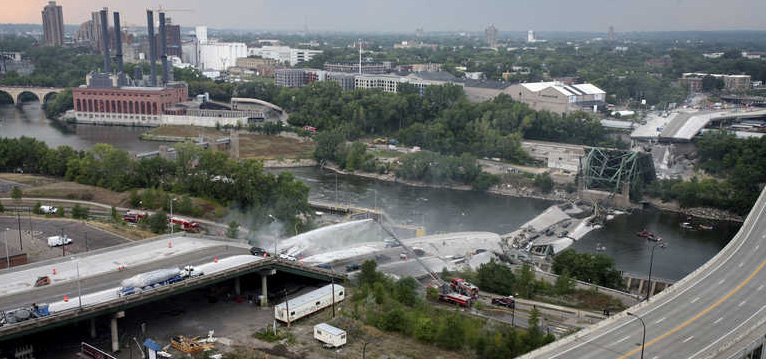
Today, August 1, between 6 and 6:15pm, the north and southbound lanes of 35W collapsed at the bridge over the Mississippi River. Here is a Google Map of the location. The bridge, built in 1967, was undergoing routine repairs to the bridge deck this summer, but not to the underlying structural girders. Crews working to repair the bridge were on site at the time of the collapse; their status is currently unknown. A school bus full of children was on the bridge during the collapse; they were all evacuated safely from the back of the bus. At least one casualty has been confirmed, though I have heard reports of up to 3 dead. At around 7:30pm, I heard reports of 16+ injured.
Here’s what I saw on the news: aerial footage by helicopters showed a center section of the bridge essentially flat in the water, with some cars upended in the river and others still on the pavement. Despite the debris in the water, law enforcement boats were able to get to the cars, which I believe aided water rescue. At the edges, near the banks of the river, part of the bridge deck on the east bank was at an extreme (60+ degree) angle, apparently still resting on the east bank base. However, on the west bank, part of the bridge collapsed onto another part, trapping cars in a sandwich between pieces of bridge deck.
International News: The BBC is leading with an article about this - “The US Department of Homeland Security said there was no reason to suspect the fall of the bridge, which had been undergoing repairs, was terror-related.”
Here is my comment attached to the Newsvine article:
I live in the area, and I’m following the coverage on the local CBS affiliate. The school bus occupants are all confirmed to be safe.
Of interest to those commuting in the area: as of right now, northbound 35W traffic has been rerouted to 280, using a detour running for a bit on I94. 94 is the one of the main east/west arteries through the Twin Cities area, so it is possible that rush hour tomorrow morning could be particularly bad on 94, in addition to the expected problems on 35W itself. However, I would check early in the morning for traffic reports to see how the detours are being handled at that point.
Another note: airspace has been under certain limitations in the area, due both to severe weather and local emergency hospital helicopters. I am unsure if this effects air travel into and out of the MSP international airport nearby. Check on flight times if you are expecting to leave or arrive in the next 12 hours.
A 2001 evaluation of the bridge, prepared for the state transportation department by the University of Minnesota Civil Engineering Department, reported that there were preliminary signs of fatigue on the steel truss section under the roadway, but no cracking. It said there was no need for the transportation department to replace the bridge because of fatigue cracking.
Senator Norm Coleman of Minnesota told CNN that the bridge had received a “clean bill of health” three years ago. He said the construction work occurring on the bridge was a resurfacing project, not uncommon in Minnesota during the summer months.
This entire situation is just shocking: after putting in all the voicemails to Mykala that I could, I stared at the news coverage for a couple of hours, as more details trickled in. One reporter said that, in his entire career, he had never seen so many law enforcement and emergency vehicles in one place. Additionally, the area seemed difficult to access: firefighters had to string hoses for over a mile in order to get water to the burning Tastee bread truck that was sending huge plumes of black smoke into the sky around 6:30pm.
UPDATE, 10:38pm : 7 fatalities confirmed. 50 cars on the bridge at the time of collapse. Search off for tonight, rescue efforts resume at sunrise tomorrow. Information on donating needed blood is available at this website, or at 1-888-GIVE-BLD.
Twenty-five additional buses from north metro Park and Ride lots are being run by Metro Transit.
One of the 18 bridge workers on the bridge at the time of the collapse remains unaccounted for.
UPDATE, 11:19pm :HCMC is the epicenter for treatment; thankfully, they are a Level 1 trauma center, meaning they are very well equipped to deal with exactly this type of situation (surgeons, etc. on call 24 hours per day). Four of the six critically injured patients have already undergone surgery.
UPDATE, 11:28pm : Minimum 60 people have been reported injured. It is believed that all who were in cars have been rescued. The bridge passed routine inspections as recently as 2005; thus, the cause of this collapse remains unknown. As stated before, there is currently thought to be no link to terrorism.
UPDATE, August 2, 9:25am : Casualty count dropped to 4, but since there are 20 people missing, I can’t see this staying the case. It turns out the Twins game at the Metrodome last night was still played, partially because releasing the entire crowd onto the roads would’ve caused countless logistical problems. Also, CNN has a security camera video of the bridge collapsing.
Inspectors gave the bridge a sufficiency rating of 50 percent on a scale of 0 to 100 percent. A rating of 50 percent or lower means the bridge might need to be replaced.
The condition of I-beams, girders and other components called “structural members” was rated four on a scale of 0 to nine. A rating of 0 means failed, nine means excellent. Inspectors look at these for signs of distress such as cracking, deterioration, section loss and malfunction and misalignment of bearings. The deck received a rating of five and the substructure rating was six.
The article continues with some interesting details about the bridge construction, including the fact that it was not built with redundancy in the main span… as I read it, this can create a “house of cards” effect, where if one critical piece collapses, the whole thing goes down:
Still, engineers said the fatigue cracking was a serious issue due to the lack of redundancy in the main truss system. Only two planes supported eight lanes of traffic, they wrote.
“The truss is determinate and the joints are theoretically pinned,” the report states. “Therefore, if one member were severed by a fatigue crack, the plane of the main truss would, theoretically, collapse.”
Furthermore, the morning rush hour has been manageable for many commuters; interestingly enough, “With suggested detours, Highway 280 is becoming the new 35W. Traffic lights on streets near 280 have been turned off to accommodate the detour.” Let me tell you something: 35W is a mess; with the construction a few miles north of this catastrophe at 35W and 694 (the unweave the weave project), traffic was already goofy enough. However, with the new change of 280 being the chief detour for 35W… things are going to be jammed up. 280 is a narrow connecting highway that was clearly designed to be low volume (short entrance ramps, narrow lanes); hopefully it can manage the increased demand.
UPDATE, 2:32pm : As suspected, and confirmed during a 30 second viewing earlier today: Fox ‘news’ sucks just as much, if not more, than ever.
Yesterday, I uninstalled my family’s old microwave from the wall on which it hung for over a decade. The darn thing weighed 90+ pounds. The thing is, though, I had help (and I needed help; I had no idea how to get the contraption off the wall). My grandpa Bup was there: he’s 81. The thing is, Bup is still downright sprightly - he brought over a bucket of tools appropriate for the job, and immediately set to work.
Now, the majority of a wall-mounted microwave’s weight sits on the lower lip of a wall plate; the reason for this is twofold: (1) this distributes the force of the microwave over 4+ screws and (2) hanging and unhanging the microwave can be done by setting it on the lip and rotating it into place. Thus, getting the microwave off the wall was pretty easy — the biggest difficulty confronted was removing the back plate on which the microwave sat. In order to support the weight of this thing in dry wall, toggle bolts with socket cap screws were used. Removal should’ve been, in theory, easy. However, it seemed that the metal of the toggle’s corroded, causing them to grip the screws much too tightly. To remove the hardware, Bup and myself had to push and pull in opposite directions. I was pushing a drill set on reverse into the wall while he was pulling back to set the wings of the toggle against the opposite side of the dry wall. This meant the screw could actually unscrew instead of simply spinning in the wall. So there we were, me and my 81 year old grandpa, pouring sweat into our tug of war and trying to get these screws out of the wall.
I can’t believe how strong my grandpa is for someone very nearly 4 times my age. In addition to the mounting plate difficulty, he carried the microwave out of the house with me! I know exactly how much work it is to carry the thing (after all, I was on the other end), and I was amazed at his stamina. It’s just awesome that Bup is still doing so well; I can only hope I have that much energy down the road. After all the work was done, we all went out to Perkin’s; there’s something very grounding about spending time with three generations of your family.