Lamp


For Mykala, for Valentine’s Day.
Skills I would like to learn:
Things I vehemently oppose:
Role models:
Mister Rogers. Tom Junod, in Esquire:
Mister Rogers went onstage to accept the award — and there, in front of all the soap opera stars and talk show sinceratrons, in front of all the jutting man-tanned jaws and jutting saltwater bosoms, he made his small bow and said into the microphone, “All of us have special ones who have loved us into being. Would you just take, along with me, ten seconds to think of the people who have helped you become who you are. Ten seconds of silence.
And then he lifted his wrist, looked at the audience, looked at his watch, and said, ‘I’ll watch the time.” There was, at first, a small whoop from the crowd, a giddy, strangled hiccup of laughter, as people realized that he wasn’t kidding, that Mister Rogers was not some convenient eunuch, but rather a man, an authority figure who actually expected them to do what he asked. And so they did. One second, two seconds, seven seconds — and now the jaws clenched, and the bosoms heaved, and the mascara ran, and the tears fell upon the beglittered gathering like rain leaking down a crystal chandelier. And Mister Rogers finally looked up from his watch and said softly, “May God be with you,” to all his vanquished children.
Su Song. From Wikipedia:
Su Song was most famous for his hydraulic-powered astronomical clock tower, crowned with a mechanically-driven armillary sphere, which was erected in the capital city of Kaifeng in the year 1088. His clock tower employed the escapement mechanism two centuries before it was applied in clocks of Europe; the tower also featured the earliest known endless power-transmitting chain drive in the world, as outlined in his horological treatise of 1092.
Gottfried Leibniz. Paul du Bois-Reymond, in a biography about Leibniz:
As is well known, the theory of the maxima and minima of functions was indebted to [Leibniz] for the greatest progress through the discovery of the method of tangents. Well, he conceives God in the creation of the world like a mathematician who is solving a minimum problem, or rather, in our modern phraseology, a problem in the calculus of variations — the question being to determine among an infinite number of possible worlds, that for which the sum of necessary evil is a minimum.
Your thoughts, as always, are quite welcome.
Derek Powazek tells The Real Story of JPG Magazine. He has some helpful words of wisdom:
Decisions aren’t decisions if you have to keep making them. Set on the course and stick to it. If you keep talking about things that have already been decided, nothing will ever get done.
and…
Never let anyone tell you what you want. When someone says, “You don’t want that,” what they really mean is, “I don’t want you to have that.”
It literally got my adrenalin pumping to read how Derek wrestled with the tension small businesses create — there are people who are honest and kind, but sharing a business with another person who is neither of those things creates a crisis. That is, in a purely interpersonal relationship you can forgive and forget, but in a business you can be forced out, wrongly accused, and legally outmaneuvered until all you’re left with is the option to forget the business you started. It’s hard to find people to trust, doubly hard when you share a business with them.
NFL teams have too many managers and too few resources to manage, writes Gregg Easterbrook at his ESPN column Tuesday Morning Quarterback:
If General Electric had the same ratio of titles to revenue as the Patriots, GE would employ 652 presidents, 1,304 executive directors, 1,956 chief officers and 9,780 directors.
Check out some of the examples:
- Tennessee’s Bud Adams Jr. officially calls himself owner/chairman of the board/CEO/president.
- At Dallas, Jerry Jones and his son Stephen have awarded themselves these six titles: owner, president, general manager, chief operating officer, executive vice president and director of player personnel.
- The Patriots, this year’s winner for most top-heavy front office, have a chairman and CEO, a president, a vice president of player personnel, a chief administrative officer, a chief financial officer, a chief operating officer, three other vice presidents, two executive directors, two people who both hold the title director of sales, a director of strategic initiatives, and 12 other directors.
It’s like a league of a bunch of man-boys saying “mee oooh mee, I wanna be a manager for a football team!” Bleck.

My favorite one is the one on the top left. First things first: a table.
An article entitled “Math Trek: The Grammy in Mathematics” from Science News Online explains how Jamie Howarth, with the help of mathematician Kevin Short, used an awesome technique to restore an old Woody Guthrie recording (emphasis mine):
Howarth had developed algorithms to correct these recordings. He looks for extraneous sounds, like an air conditioner or fan in the background that creates a rhythmic sound. Instead of simply removing these sounds, he uses them as a clock, a kind of built-in foot-beat in the recording that tells him what the true timing should be. When a recording is made, this background rhythm is even. But when it’s played back, it speeds up and slows down in perfect timing with the errors in the recording. That allows Howarth to adjust the timing of the recording to make it much more similar to the original sound.
When Howarth isn’t lucky enough to find a rhythmic background noise, he has another technique. He has found that all analog recordings contain a sort of rhythmic buzz at a specific frequency way above human hearing. This buzz can substitute for a background fan.
Howarth had successfully used these techniques to restore other old recordings, like the film soundtracks for Oklahoma! and Close Encounters of the Third Kind. But the Guthrie recording was such a mess that it forced him to develop new techniques. He turned to Kevin Short, a mathematician at the University of New Hampshire who had done work on signal processing for sound compression.
The team discovered the many ways that wire makes a lousy material for sound recording. One problem is that wire’s round. When the wire kinked, it would twist out of position and the head would no longer be reading the proper side of the wire. The machine still read the low and medium frequencies, but the very high frequency sounds dropped out—including the signal Howarth used as his foot-beat.
Short developed techniques to interpolate the missing information. “We could actually pick up a hum from the Con Edison power supplies,” Short says. “It’s a pretty nasty noise.” Because that hum was lower frequency, it remained even in the twisted sections. Short also brought in more sophisticated techniques to shift the pitches once the algorithm had identified what needed to be done.
That is really really cool. Be sure to check out the article to hear the before and after soundclips, which are impressive.
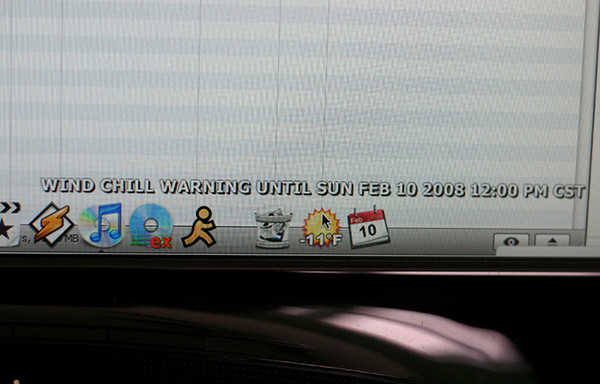
Windchills made it to 40 below this morning.

Like this sticker.

Nothing says “I follow the crowds” like taking a picture of a Moleskine planner with a 50mm f/1.8 “nifty fifty.”
↓ More