Seeing eye cats are like seeing eye dogs, except they are the eyes for the dogs and the dogs are the disabled ones:
Cashew, a 14 year old Labrador Retriever owned by Terry
Burns in Middleburg, Pennsylvania, is blind and deaf. Her best
friend is a red tabby cat named Libby. Libby has
become Cashew’s seeing-eye cat. She guides Cashew
around obstacles, leads her to the food dish and even
sleeps next to her every night.
The picture of the intrepid cat leading the dog along is great. (Via Jezebel).
Facebook efficiently stores ~6.5 billion images, in 4 or 5
sizes each, totaling ~30 billion files, and a total of 540 TB
and serving 475,000 images per second at peak…
I remember when Facebook released their pictures application, and I thought “this is silly.” And then everyone I’ve ever known started adding pictures and I realized that my desire to “keep it simple, stupid” was, itself, stupid.
Now, here we are, with 6.5 BILLIONIMAGES on Facebook. The truly amazing thing is that last number: almost a HALFMILLIONIMAGESPERSECOND. Some people in the internet industry might say that serving that many requests per second isn’t that difficult… but I think these Facebook engineers deserve some serious, serious respect… this is tough stuff they are doing.
The Sartorialist features a quick illustration of “(The Original) John Lobb, London.” Check out the relentless authenticity of this place. First off, William Lobb is a 5th generation shoemaker in London. What’s that, 150+ years of shoemaking? Above the front door there are coats of arms. An example of the caption below one:
Then there’s Frank Sinatra’s boot last amongst Lobb’s huge collection of lasts. THEN, there’s the outrageously cool leather-bound sales records, stacked to the ceiling on engraved, dark wooden shelves.
In an era of faux finishes and a paucity of historical significance, it’s fascinating to see such an authentic, focused place still in business.
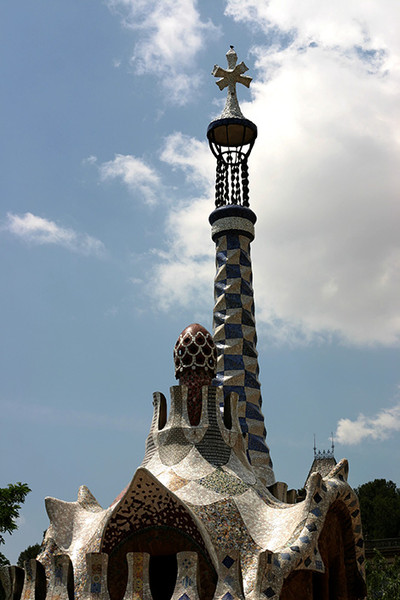
Park Güell is almost surreal in how far ahead of its time it was — it was meant to be a luxury gated community sitting at the top of Barcelona. The plans for it, with its gatehouses, wall, community markets and spaces, and meticulously planned lots look exactly like modern suburbia on paper. Unfortunately, the park was a financial failure and one of the only houses that was actually built there was Gaudí’s own.
Today, the area is a wonderful park where, on warm days, musicians play under stone arched paths. Quite a nice retreat from the busy city.
Without mortality—that is, if we lived forever, uncaring of
the ticking of clocks—would we have need of religion,
of families with children for a new generation, of dreams for
a better future? Wouldn’t scientists lose their urgency
to discover, artists to create? Without my ever-keener
awareness of Jean’s and my mortality, I certainly wouldn’t
be writing this account in my 87th year. And what about
love? As lyrical expressions, sonnets typically represent
the poet’s personal emotions. One sonnet in particular,
by Shakespeare, moves both Jean and me; I liked it as
a graduate student, but not in the way I do today. The
first-person narrator acknowledges that life, like a fire, is
consumed by the source nourishing it, and tells his beloved
in the concluding couplet, “This thou perceiv’st, which makes
thy love more strong, / To love that well which thou must
leave ere long.”
The life-long retrospective in this essay is massive in scope and as a result, variegated in message. Should you have time on this sunny beautiful summer day, though, have a sit down and read it, mindful of youth and the opportunities it affords.
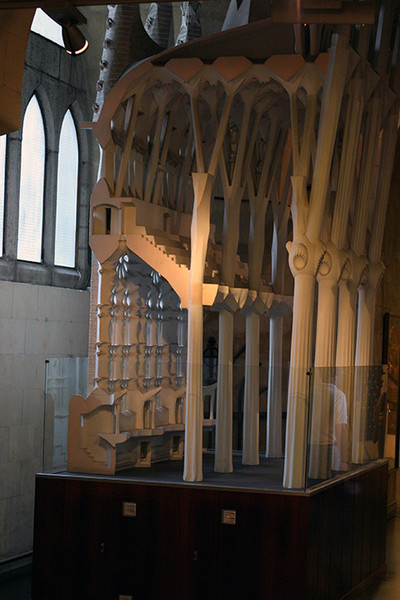
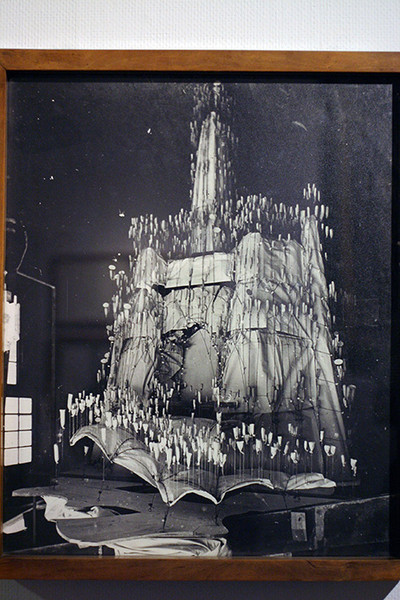
Here’s a quick physics idea: compression forces can be modeled as tension forces. And that’s exactly what Gaudí did in order to get the angles of his fantastic arches correct.
Take a close look at what’s going on here — this is a photograph that has been turned upside down.
What Gaudí did was connect chains in the pattern he wanted for his arches. Then, he attached small bags of lead shot to the lowest ends of the chains, putting tension on them. The resulting angles and proportions that Gaudí’s simulation produced meant he could flip the photo upside down, trace it, and get a stunningly accurate (and stable!) blueprint for the desired structure.