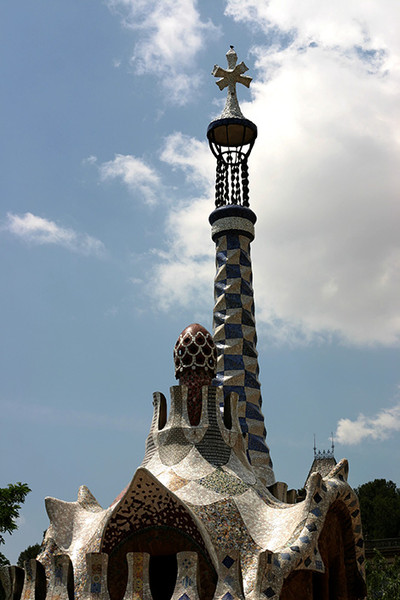
Park Güell is almost surreal in how far ahead of its time it was — it was meant to be a luxury gated community sitting at the top of Barcelona. The plans for it, with its gatehouses, wall, community markets and spaces, and meticulously planned lots look exactly like modern suburbia on paper. Unfortunately, the park was a financial failure and one of the only houses that was actually built there was Gaudí’s own.
Today, the area is a wonderful park where, on warm days, musicians play under stone arched paths. Quite a nice retreat from the busy city.
Without mortality—that is, if we lived forever, uncaring of
the ticking of clocks—would we have need of religion,
of families with children for a new generation, of dreams for
a better future? Wouldn’t scientists lose their urgency
to discover, artists to create? Without my ever-keener
awareness of Jean’s and my mortality, I certainly wouldn’t
be writing this account in my 87th year. And what about
love? As lyrical expressions, sonnets typically represent
the poet’s personal emotions. One sonnet in particular,
by Shakespeare, moves both Jean and me; I liked it as
a graduate student, but not in the way I do today. The
first-person narrator acknowledges that life, like a fire, is
consumed by the source nourishing it, and tells his beloved
in the concluding couplet, “This thou perceiv’st, which makes
thy love more strong, / To love that well which thou must
leave ere long.”
The life-long retrospective in this essay is massive in scope and as a result, variegated in message. Should you have time on this sunny beautiful summer day, though, have a sit down and read it, mindful of youth and the opportunities it affords.
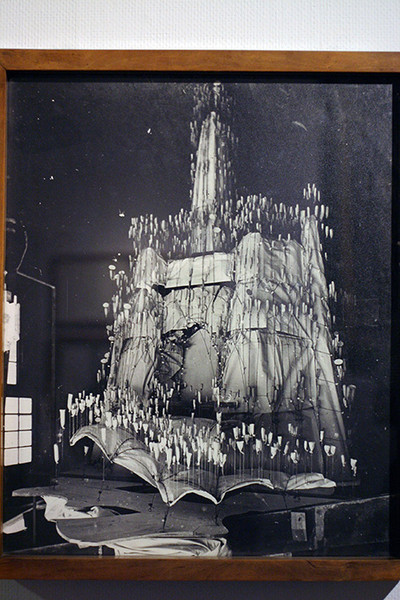
Here’s a quick physics idea: compression forces can be modeled as tension forces. And that’s exactly what Gaudí did in order to get the angles of his fantastic arches correct.
Take a close look at what’s going on here — this is a photograph that has been turned upside down.
What Gaudí did was connect chains in the pattern he wanted for his arches. Then, he attached small bags of lead shot to the lowest ends of the chains, putting tension on them. The resulting angles and proportions that Gaudí’s simulation produced meant he could flip the photo upside down, trace it, and get a stunningly accurate (and stable!) blueprint for the desired structure.
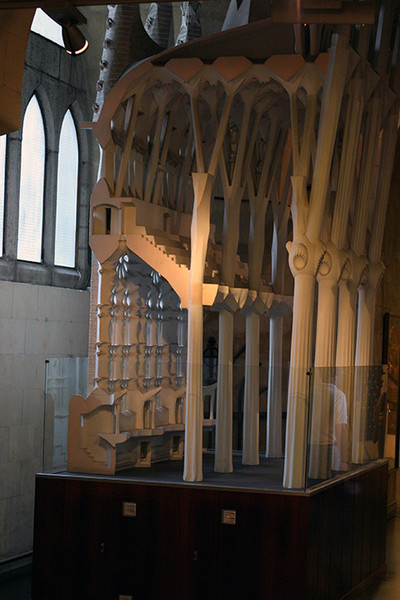
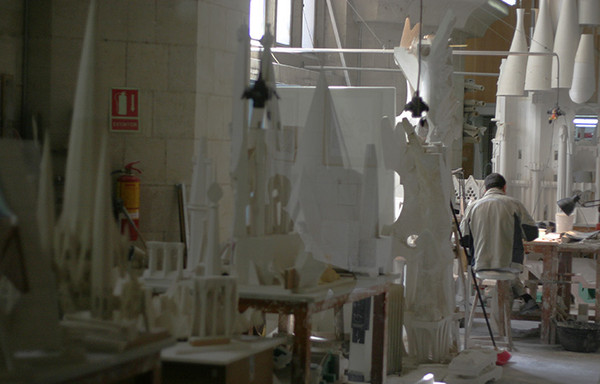
Here’s one the most amazing parts of the whole tour: the cathedral is still under construction, so a small cadre of artists and craftsmen continue their work under the eyes of tourists. One critical component of Gaudí’s method was the use of plaster models — this workshop continues to produce those models so construction can continue.
Gaudí obsessed over this cathedral, and realizing it would never come close to completion during his time, labored with absolute dedication in the latter part of his life to drawing up plans, models, and details so that work could continue long after his death. Unfortunately, most of his work was destroyed during the revolution, but was painstakingly pieced together again when the political climate stabilized. These reconstructed plans direct the construction today.
Not so long ago, somebody looked at the heaps of tennis shoes and car tires piling up in landfills and thought “we can grind these up and sell the pieces!” Since then, these useful scrap rubber bits have been employed in a variety of ways, including replacement for gravel on playgrounds.
The material is, in many ways, an improvement over gravel: softer when trod upon, a nice radiator of heat on those chilly Minnesota spring days, and a good use of material that would go to waste. Unfortunate side effect: warm rubber has a biting, putrid scent. You can’t smell the fresh cut grass or the summer breeze; it smells like you are inside the world’s biggest tire.
I am just so unbelievably excited to own my own business fixing people’s teeth, I can barely stand it. If you’re in the Twin Cities area five years from now, and your tooth hurts, please do look me up.