I submit this to you: the movie Wall•E is an instant classic. Instant. New York Times columnist Frank Rich, in “Wall-E for President”:
Indeed, sitting among rapt children mostly under 12, I felt as if I’d stepped through a looking glass. This movie seemed more realistically in touch with what troubles America this year than either the substance or the players of the political food fight beyond the multiplex’s walls.
While the real-life grown-ups on TV were again rebooting Vietnam, the kids at “Wall-E” were in deep contemplation of a world in peril — and of the future that is theirs to make what they will of it. Compare any 10 minutes of the movie with 10 minutes of any cable-news channel, and you’ll soon be asking: Exactly who are the adults in our country and who are the cartoon characters?
It is not good: our news-as-entertainment fails so miserably that our entertainment must step in to fill the void.
In this calm before an approaching intellectual storm of more school, I find all the energies of my brain bent on the Big Questions™. I’ve always found it interesting that I only begin to ponder these questions when the day-to-day worries of my life are at a local minima — indeed, the vast majority of folks are just too busy to care. Sadly, I’ll soon rejoin that majority. That reminds me of a piece from a great article (certainly the best item I’ve read about higher education since Nussbaum’s “Cultivating Humanity”) entitled “The Disadvantages of an Elite Education” by William Deresiewicz:
Places like Yale are simply not set up to help students ask the big questions. I don’t think there ever was a golden age of intellectualism in the American university, but in the 19th century students might at least have had a chance to hear such questions raised in chapel or in the literary societies and debating clubs that flourished on campus. Throughout much of the 20th century, with the growth of the humanistic ideal in American colleges, students might have encountered the big questions in the classrooms of professors possessed of a strong sense of pedagogic mission. Teachers like that still exist in this country, but the increasingly dire exigencies of academic professionalization have made them all but extinct at elite universities. Professors at top research institutions are valued exclusively for the quality of their scholarly work; time spent on teaching is time lost. If students want a conversion experience, they’re better off at a liberal arts college.
When elite universities boast that they teach their students how to think, they mean that they teach them the analytic and rhetorical skills necessary for success in law or medicine or science or business. But a humanistic education is supposed to mean something more than that, as universities still dimly feel. So when students get to college, they hear a couple of speeches telling them to ask the big questions, and when they graduate, they hear a couple more speeches telling them to ask the big questions. And in between, they spend four years taking courses that train them to ask the little questions—specialized courses, taught by specialized professors, aimed at specialized students. Although the notion of breadth is implicit in the very idea of a liberal arts education, the admissions process increasingly selects for kids who have already begun to think of themselves in specialized terms—the junior journalist, the budding astronomer, the language prodigy. We are slouching, even at elite schools, toward a glorified form of vocational training.
I think the problems with an “elite education” outlined in this article have trickled down to the institutions in the tiers below “elite”. The time to focus on these boggling questions was, formerly, the college years. Now, college is so focused on manufacturing workforce drones that, as Deresiewicz writes, “Our best universities have forgotten that the reason they exist is to make minds, not careers.” But anyhow. The Big Questions, I spoke of…
Sure, there’s the “why am I here?” and the “what’s my purpose?” type queries. Lately, though, I’ve been more concerned with the “what is humanity’s future?” question. It would seem we are headed for some rather difficult times. One look at the unbelievably explosive exponential growth of population shows that soon there will simply be too many people. Not too many people in a certain area, or too many people using too much energy… no. There will simply be too many people. As in, we won’t be able to feed them all. That kind of Too Many.
Paul Roberts, the author of The End of Food, recently gave a speech centered around the topics in that book. I submit to you a transcript of the most dire portion of his talk; it’s an excerpt focused on troubles with scaling food production even further up:
The old-fashioned way of producing more food was you’d plow up more acres. Well, we have come to a point now where we don’t have that many arable farm acres that are readily available. Most of them are already growing crops. Most of what’s left are doing things like, supporting forests. Brazil’s massive agricultural expansion you may have read about has come almost entirely at the expense of its rainforests, which will have huge environmental and political and cultural costs.
Well, we’ve run into land scarcity before; we’ve always found ways to increase the yield per acre, grow more bushels per acre. We’ve done it before with fertilizers and we’ll do it again with transgenic crops. That’s the expectation. And farmers will have new tools, but they will also have new constraints. We already know that oil… this is a very oil intensive business, making food, it takes a lot of oil for tractors, it takes a lot of oil to move the food from the farm to the factory and from the factory to the store. Well, keep in mind that this is a food system that was designed for oil at $15 a barrel. The fact that oil is probably going to be at 10 times that figure in the forseeable future really raises questions as to how sustainable this food system is.
And there’s a huge focus on oil, but consider natural gas. Natural gas, like oil, is becoming scarce and more expensive and natural gas is also the primary ingredient to make what? Fertilizers. Fertilizers have more than tripled in price over the past 12 months, and keep in mind that 40% of the calories we produce on this planet are directly attributable to the availability of cheap nitrogen fertilizer. So, imagine how we’re going to get through the next 50 years and another 4 billion people with fertilizer that’s three to four to five times above the historic trend. It’s breathtaking, how is that going to happen? And, you know, fertilizer is just the beginning.
You need a lot of water to grow food. It takes, on average, and I’m sure you’ve seen this figure, 1000 tons of water to grow 1 ton of grain. Or up to that amount. So that means, to grow that additional billion tons of grain, we’ll need about a trillion tons of water a year, and this on a planet that’s already seriously overdrawing its water supplies. India and China now support 1/6th of their populations on irrigation systems that are overdrawing the aquifer. They are now having to drill down thousands of feet to catch these falling water tables.
In fact, we’re running into the same problems here in the United States. Some countries are now overcoming these water shortages by importing their water in the form of soybeans and corn; the Chinese do this a lot. They would much rather have farmers in Argentina and Brazil user their water, and then ship the grain to China, rather than use water at home. But, given that we’ll probably need about 20% more water than we believe is currently available, this water trade that we’ve developed only works to a point. So, we’re going to have to find a way to produce more food with less water.
And lastly, we’ve got climate. Everyone understands, intrinsically, that if temperatures change, rainfall changes, it’s going to impact your crops. But we focus really heavily on Africa, because we can already see how climate is affecting output there, and we can see that, for example, that their ability to grow wheat is probably going to be gone by the middle of the century. And since Africa is already a basket case, there’s a lot of concern what climate means.
But what we need to focus more on is what climate is going to do to countries like the United States. Under most of the scenarios, we’re going to see more weather like we’re seeing out in the midwest right now. People are describing these floods that have pretty much wiped out most of the planting of the corn and soybeans for this year — they are describing this as a 50 year flood, and then they describe it as a 100 year flood. Well, under most climate scenarios its going to be more like a once or twice a decade flood. So, we’re setting ourselves up for a situation in which, just at the time that regions like Africa are most in need of our exportable surplus, we won’t be able to do it. And we’re just kind of merrily trundling on toward that — we’re complaining about things like ethanol and saying, well, transgenic crops are going to solve everything. Well, we’re not even close. We’re not even on the same page. The crisis that is looming in front of us is one that’s going to require a completely different way of thinking.
I believe we’re not yet condemned to an unavoidable fall — but the incredible stress we’re putting on land, oil, and water resources will need to be mitigated by a holistic reexamination of almost every facet of modern life: energy production, water management, interdependent biological systems (animals + plants rather than isolation of these), and large-scale movement of goods. The pains of re-establishing the world equilibrium we’ve abandoned for the past 200 years are going to be shocking; certainly, they could be violent. It is bound to be, as I am wont to say, “a brave new world”.
It may not be this generation, but it can’t be far away: soon the price of real estate will not be based on proximity to the ocean or major metropolitan areas, but on the availability of fresh water and access to arable land. And that is only the beginning.
P.S. As a responsible world citizen and steward of this planet (could I use any more buzz phrases?), I encourage you to listen to all 53 minutes of Paul Robert’s speech. I don’t want anyone to agree with everything he says and I certainly am not telling you to buy his book — it’s just that his speech is an excellent introduction to the scale of the difficulties facing the world. We can’t simply go elsewhere and hit a goldmine of natural resources anymore. The earth has been explored. We’re bursting at the seams.
P.P.S. If you’re wondering where this will all hit first, think of the order of needs: water, food, shelter. Where is water supply dwindling quickly? India. The American Southwest.
P.P.P.S. This reminds me of a W.B. Yeats poem, entitled “The Second Coming.” (A few quick notes about Yeats… you can essentially outline his life with all the marriage proposals he made… I think it was something like 8, and 7 to the same woman. Something crazy like that. Plus, he had some crazy superstitious beliefs, and was totally committed to the idea of an elite class of rulers. The guy was kind of weird. Good poet, though.) Anyhow, the poem: it’s about civilization reaching its peak after 2000 years. An excerpt:
Things fall apart; the center cannot hold;
Mere anarchy is loosed upon the world,
The blood-dimmed tide is loosed, and everywhere
The ceremony of innocence is drowned;
The best lack all conviction, while the worst
Are full of passionate intensity.
…
That twenty centuries of stony sleep
Were vexed to nightmare by a rocking cradle,
And what rough beast, its hour come round at last,
Slouches towards Bethlehem to be born?
P.P.P.P.S. This is depressing, scary stuff. I know.
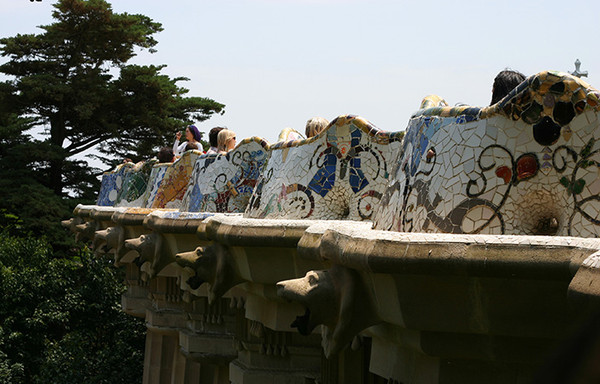
Here’s the top of the open-air market I wrote about a few pictures ago. Incidentally, a continuous concrete bench lines the perimeter — Gaudí was obsessed with making chairs that conformed to the human physiology… and these things are a testament to his skill at that. They’re incredibly comfortable! If only all benches were this comfortable.