My thinking, years ago, went like this: people, groups of people, compete for limited resources. Even if one side is consistently committed to negotiation, to peaceful compromise (even if BOTH are), physical aggression from a few rogues on one side will inevitably cause armed conflict. How could even the most egalitarian, humanistic leader do anything else, upon witnessing killing of their own?
This evolved to a model of cultural scapegoatism. Violence will arise when there are abundant resources, from just the perception of unfairness or moderately uneven distribution. Tribalism, jingoism, binary exclusivism will then define the in-group by negation. Which is to say, “we are wonderful, we are treated unfairly, and we are the opposite of those people over there.” Those who complain loudest seem to be those who are winning… and suffering the least. So then there’s persecution, murder, war, all metastasizing from a domineering culture who perceives the Other with stereotyping, fear, anger, distrust.
Perhaps, I reasoned, within the framework of a healthy society, one where basic needs of humans are considered, reevaluated, provided for, humanity can reach its potential. The goods and Goods from capitalism can be enjoyed and the cancerous growth of gross inequality regulated — look to Norway, I thought! See how their national competence and foresight took oil wealth and invested it to make the lives of all their residents better and pushed beyond a world powered by oil. If we just built that society, I thought, the bonfire of violence would be starved of oxygen!
And then I read about the nigh-thousand year suffering of the Cagots:
Cagots were shunned and hated. While restrictions varied
by time and place, they were typically required to live in
separate quarters in towns, called cagoteries, which
were often on the far outskirts of the villages. Cagots
were excluded from all political and social rights. They
were not allowed to marry non-Cagots, enter taverns, hold
cabarets, use public fountains, sell food or wine, touch
food in the market, work with livestock, or enter mills.
They were allowed to enter a church only by a special door
and, during the service, a rail separated them from the
other worshippers.
“Ok, ok” I thought, “it’s just another example of fighting over something important, some thing arising from insufficient resources.” But then I read further:
The Cagots were not an ethnic group, nor a religious
group. They spoke the same language as the people in an
area and generally kept the same religion as well. Their
only distinguishing feature was their descent from
families identified as Cagots. Few consistent reasons were
given as to why they should be hated; accusations varied
from Cagots being cretins, lepers, heretics, cannibals, to
simply being intrinsically evil.
Then the amorality of it, the nihilistic cruelty sunk in.
Which puts us at my thinking today: it seems to me that the human’s need for a strong sense of belonging and their concept of self is so fragile that violence cannot be blamed on conditions of intractable scarcity, or scapegoatism. No. It seems humans have an instinctual, intrinsic desire to inflict pain and suffering on another. Or, more precisely, an Other.
So that’s where I am today. I propose this: you can give a village, a people, a nation, an entire global society universal basic income, healthcare, justice, democracy, and they will destroy it, just to watch it burn. Because that is the essence of the human animal.
But we won’t know if my guess is correct until we first build that society. So let’s built it and hope I’m wrong.
“The central issue is we’re developing into a
plutocracy,” he told me. “We’ve got an enormous number of
enormously rich people that have convinced themselves
that they’re rich because they’re smart and constructive.
And they don’t like government, and they don’t like to
pay taxes.”
I agree. They’re not rich because they’re smart, they’re rich because they’re lucky. You can find the scientific summary of this in a piece by Scott Barry Kaufman:
In an attempt to shed light on this heavy issue, the
Italian physicists Alessandro Pluchino and
Andrea Raspisarda teamed up with the Italian
economist Alessio Biondo to make the first ever
attempt to quantify the role of luck and talent in
successful careers. In their prior work,
they warned against a “naive meritocracy”, in which people
actually fail to give honors and rewards to the most
competent people because of their underestimation of the
role of randomness among the determinants of success. To
formally capture this phenomenon, they proposed a “toy
mathematical model” that simulated the evolution of
careers of a collective population over a worklife of 40
years (from age 20-60).
…
In general, mediocre-but-lucky people were much more
successful than more-talented-but-unlucky individuals.
It’s not difficult to see why many people take offense
when reminded of their luck, especially those who have
received the most. Allowing for luck can dent our
self-conception. It can diminish our sense of control. It
opens up all kinds of uncomfortable questions about
obligations to other, less fortunate people.
So, here’s the point: you’ve got the Gilded Age in the early 20th century, where the increase of inequality, the dizzying heights of wealth reached by the 0.1% were stopped by a Great Depression, a World War (the second), and a rebuilding of American society based on sane taxes and regulations that reduced inequality. Today, we’re right back at that gilded level of inequality. A bunch of selfish humans want more. Some of them get more. Some of them get much much MUCH more. Introspection is limited. Philosophy non-existent. Myths of personal exceptionalism and meritocracy abound and suffocate independent, compassionate, and logical thought. Which leaves you with an eye-wateringly rich class of human who think they got there as an award for being special.
Both of the following upper-class garbage statements spell doom for a liberal democracy:
“Anyone who deserves it will succeed, just like I did.”
“My superior skills guaranteed my success.”
My journey into misanthropy grows ever darker. I wonder where the bottom is.
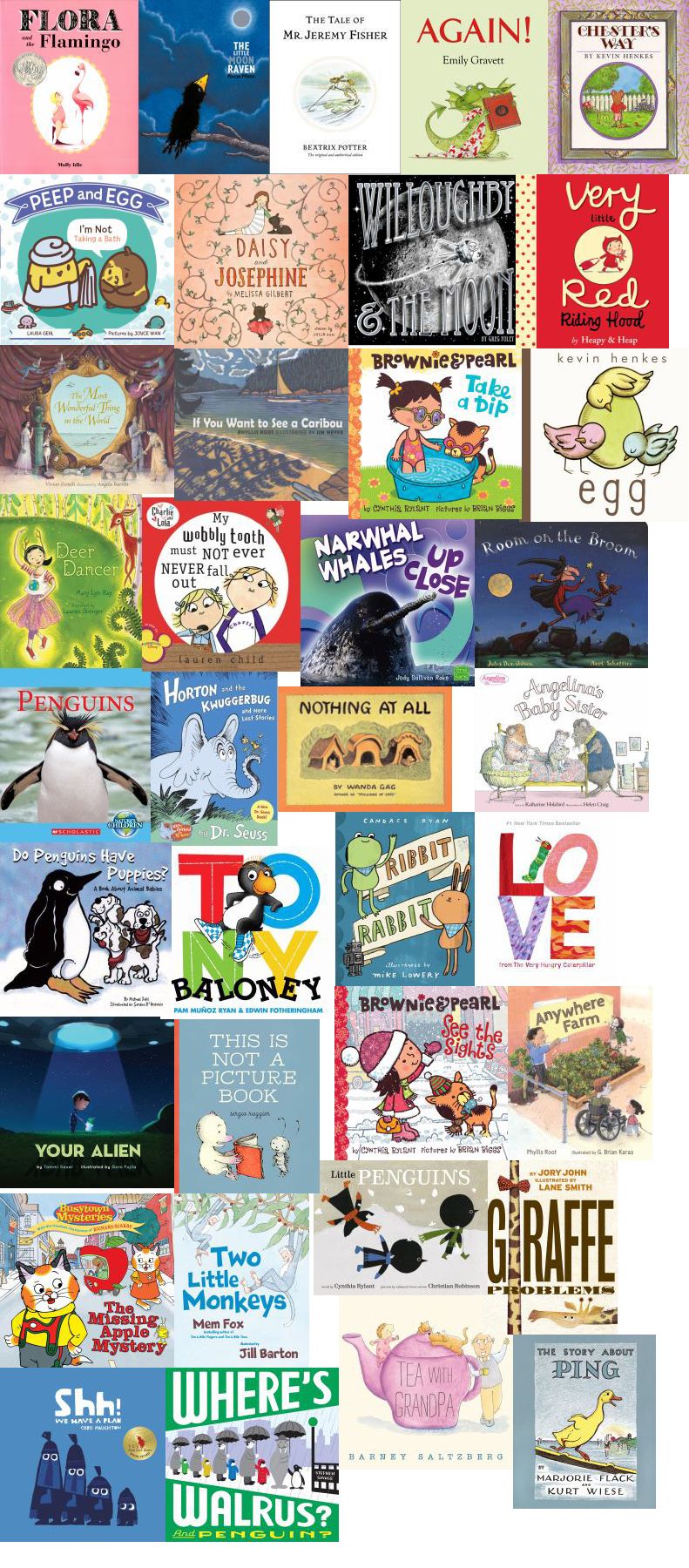
Here’s a collage of the covers of the books we currently have checked out from the library:
Ess enjoyed the narwhal and penguin fact books very much. She gets super-interested in different animals; penguins a few weeks ago. It has been ducks for the past few days.
Wanda Gág books never disappoint; plus, she was one tough woman. We’re always looking for strong female role models for Ess. Marjorie Flack is great, too. Stephen Savage’s illustrations in “Where’s Walrus? and Penguin?” are so funny. Equally delightful for adults and children.
Oh, and Kevin Henkes is some kind of magician. What an amazing author and artist.
Yesterday I sat down at our piano, a piano purchased by my mother’s mother. It is a lovely Baldwin Hamilton upright with acceptable action, lovely bright sound, surprising resonance. I play it when I can, though Ess sometimes asks me to stop. The point of this story, though: I didn’t have to earn it. It was given to me. In the care of my mom’s sister, who was moving, it found its way to me because I still played piano.
While the Jetta was in for a long repair, I borrowed my dad’s car to get to work, but also carpooled with him on Wednesdays. And he tells me about his parent’s estate. After raising twelve kids, with only his dad working (who had a high school education), when his mom died, there was still an estate left to the surviving children. This was an important infusion into my parent’s college fund for my sister and myself.
So I’m sitting there playing the piano and thinking I’m just about the luckiest damn person in the world. I’ve been given an incredible amount by my parents; and their parents set them up to be able to give me those things. Look at it all; an embarrassment of riches. I sit upon a vast inheritance of privilege, money, education that spans generations on BOTH sides of my family. I’ve never thought that good things happen to people for a reason, and thinking this through is a firm reminder that I have no credit to take for where I’ve landed. I was started with a lead-off from third base; all I had to do was run home.
This was humbling, in a good way.
I kept playing piano, thinking: I don’t feel I deserve what I’ve received because there’s no actual way I could. I’m not deserving, I’m lucky. So, the only way I can acknowledge the extent of my luck, the only way I can truly be respectful of the sacrifices made to put me where I am, is to pass on as much as I can to Essie.
At the precise moment of epiphany, there was no ray of light coming in through the clerestory window to splash onto the piano keys. Instead, George barfed immediately after I had that thought.
We’ve gone from pumpkin to Elsa to octopus to bat back to pumpkin. Pumpkin for a while. Now, we’re at penguin: Essie wants to be a penguin for Halloween. Since she has, essentially, no concept of time, we are struggling to articulate the importance of sticking with the costume once it has been ordered. When time has no meaning, Halloween is in the nebulous future, and there will always be time to order a different costume.
But here we are, the penguin costume ordered. Ess was telling me all about the hand-holes in the flippers. You know, so you can trick-or-treat.