These days, the most technologically advanced dental crowns are made from an interesting combination of materials. Before I get into that, let’s first talk about how your teeth resist breaking in twain.
The toughest building materials have a combination of strength and flexibility. Think about wood or steel: they have strength (compressibility, tension), but because their rigidity is not infinite, they also derive durability from their ability to flex and rebound under load.
In contrast, the toughest (hardest) materials, do not flex under load. They remain rigid until they shatter completely. An everyday example: your ceramic toilet bowl.
Chewing
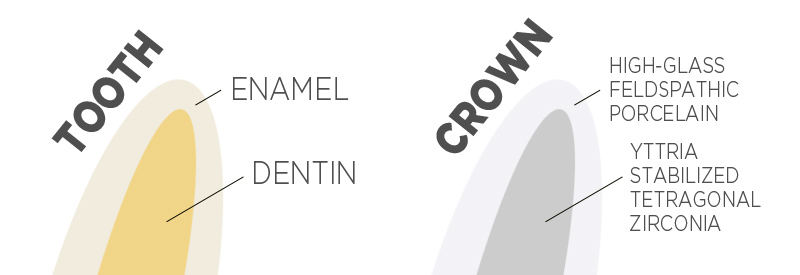
Natural teeth deal with this balance between flexibility and strength by using two different materials, laminated/fused together. The outer layer, the enamel, is hard like glass. It resists decades of food scraping on it, but it can fracture easily. Its tendency to fracture is, however, reduced by the underlying dentin, a bone-like material which flexes.
Replacing Teeth
Now, dentistry is attempting to mimic that lamination of enamel to dentin. On the inside of some solid porcelain crowns (a crown replaces the outside of your tooth) is a material classified as a yttria-stabilized tetragonal zirconia polycrystal—its an ultra-durable ceramic with a really cool property. Remember how we said ceramic tends to fracture? The yttria allows the material to stop cracks while they are tiny—the atomic crystal structure can switch over from one form to another.
It’s like this: imagine a table with four legs. If you stack things directly on top of the table, you can load it up with a ton of weight. However, let’s say your weight stack begins to drift, so that you’re putting an angular force on the table. The table top sliiides to one side: its legs are no longer perpendicular to the ground. Normally, the table would collapse at this point. However, your table has special reinforcements at the joints that let it drop into another stable position where the legs aren’t perpendicular (like a normal table), but resist the table falling over completely. Your special reinforcements are the yttria in that zirconia.
So, this is a no-glass, all crystal (remember the table) material used on the inside of these all-porcelain crowns. It is highly highly fracture resistant. But wait. No glass, you say? Isn’t glass the component of ceramic that gives it that nice translucency that lets dental techs make it look one heck of a lot like a natural tooth? Yes!
Now, we take a high-glass, brittle ceramic (feldspathic) and fuse it to the solid substructure. Just like the real tooth!
We’ve got this class taught by an amazingly well-educated fellow named Dr. Zidan. He’s taking our previous 3 operative dentistry classes and pushing the envelope on what we accept. Silver fillings (amalgam) come up… and we commonly consider these as treatment options. But then he challenges us: look at the fat margins that let bacteria in, look at the extra tooth structure removed, look at all the alternatives which provide a more esthetically pleasing result! Frankly, this is exactly what we need right now—a modern take on dentistry.
See, we’re going to come out of school with some ideas about what works, and we’ll be forced to re-invent our ideas about dentistry, because we’ll be thinking like old-fashioned practitioners already. Dental schools are known for becoming grounded in traditional methods and treatments, and holding back progress… consider the fact that we don’t even have digital x-rays yet. I think we’re one of the last schools who take traditional film-based radiographs.
So, everyday, I have to tell my patients that it’ll just be about 10-15 minutes until we get their radiographs back. And our supervising doctors still expect us to take med history, chief complaint, a full set radiographs, perio charting (6 measurements per tooth), soft tissue charting, hard tissue charting, treatment planning, AND a cleaning during the patient’s first appointment. Give me a BREAK.
Anyhow, it’s nice for someone to get up in front of the class and say “veneers are common; you should figure out how to do them while you’re still in school.” Or to say “PFM crowns don’t look as good as solid porcelain. Your patients will want solid porcelain crowns.” Or to say “I don’t know why the school hasn’t invested in digital radiography.” Then Mr. Campbell, one of the most intellectually rigorous folks in our class chimes in: “Because they spent it all on the sim clinic.” He is, of course, referencing that the school invested a PILE of money in building what is essentially a glorified dentistry video game. They wasted money that could have gone toward digital radiographs.
We’re stuck taking film pictures in a digital camera age, and all we have to show for it is a room of dental video games.
The simple truth is that public sentiment in America is
the reason that solitary confinement has exploded in this
country, even as other Western nations have taken steps
to reduce it. This is the dark side of American
exceptionalism. With little concern or demurral, we have
consigned tens of thousands of our own citizens to
conditions that horrified our highest court a century
ago.
I continue to be astounded by the lucid style and gripping story-telling of Dr. Atul Gawande. Given his position as a practicing surgeon and faculty at Harvard, I do not understand how he finds the hours to do the journalistic interviews with the subjects of his articles. On top of that, he writes books. Truly breathtaking time-management.
My favorite posts to read a few years down the road are the “things that are happening” posts. I find them much more interesting than whatever article was holding my interest at the time. Incidentally, I’m most motivated to post the “holding my interest” stuff over the life-happenings stuff. Paradoxical, no?
Bachelor Party
I went to Steve’s bachelor party, hosted by John. It was really really fun. I wish we could’ve stayed until 4 in the morning, but since we’re almost grown-ups now, we can only do that occasionally. Steve’s friends who I hadn’t met (Brian and Levi) were really cool, which made the whole event relaxed. John did a great job of making us all comfortable, entertained, and fed—it was really a good time. I particularly enjoyed reminiscing about some of the times that Steve has been coerced into doing things that are hilarious. His escapades dressing up as a woman for one of Nils’ movies will always always be funny. I really hope to see more of Steve and Nils in the coming months and years; they’re really good people I’ve fallen out of touch with. It’s completely comfortable to talk to them, even though it only happens occasionally, and I’d like to be their friends in the present-tense again. Incidentally, I’ve fallen out of touch with people from college, too (DAN, MARKOE, to start)—it’s starting to be downright shameful. I’ve got to make time. I came home from the bachelor party smelling like fire, and overjoyed to see my wonderful wife (Mykala).
Sleeping In
Regarding my previous comment about the bachelor party, I find something healthy in staying up late and then sleeping in. Here’s an interesting anecdote: our landlord, Mary Alice, is currently boarding an Egyptian named Ahmad. At 37, this is his first time out of the country… he is here to teach Arabic to the local elementary children. We see him around the duplex fairly regularly; I talked to him about his teeth (he’s having some sensitivity after his flight over), and learned more about him. His family misses him (his 2 boys, especially), and he said he feels lonely. “Alex”, he says, “there is nobody around here, you see. In Cairo, on just a normal night like this, I would be out until 1 or 2 in the morning; there many people everywhere, and so many coffee shops open at this time.” It seems to me that this late night activity encourages a sort of camaraderie that one doesn’t get during daytime activities. I find it odd that our entire country seems to go to bed early. Ahmad gave us two bookmarks and one scene from the book of the dead, printed on actual papyrus. I found this gift quite thoughtful; we intend to frame it.
Apple Orchards
Mykala and I visited an apple orchard (Aamodt’s Apple in Stillwater), and found it really REALLY crowded compared to last year. I realized, belatedly, that we went on a Friday afternoon last year. Incidentally, the people there were rather unpleasant; “annoyingly entitled” was Mykala’s description. Hopefully, we can go again on a day with smaller crowds. We visited my old house in Stillwater (I think), and talked about what the future might bring: where I might work, where we might live. It’s all possibilities right now, no limitations.
Mary Alice
Last Monday, we visited our landlord Mary Alice in the E.R. She is in her 70s (we think), and is still an active real estate agent. As such, she was preparing a house down the street for a showing, and tripped over a vine in the yard, taking a tumble off of a five foot retaining wall onto the concrete sidewalk. Ahmad stopped by at about 8pm to give us the bad news, just as Mykala was getting home from work. We hesitated, and Mykala asked “what would you do in this situation, at home in Cairo?” Ahmad replied that, of course, he and his neighbors would go and visit whomever was in the hospital. So, we all drove down to the University of Minnesota ER to visit Mary Alice. Thankfully, two neighbors were there as well, tending to the details, as Mary Alice’s family lives on the West coast. She had to have her head wounds stapled closed, and the pain from her injured back was such that she had two doses of morphine in her system by the time we visited. When we came in, she took Mykala’s hand and immediately asked “how is school?” The attending, who was cleaning Mary Alice’s head, tried to explain things, stating the amount of morphine administered. This was completely normal behavior, however—it was clear the pain medications were doing their job. We haven’t heard anything since, but we are hoping Mary Alice quickly recovers; she is an institution in the neighborhood.
Walking
Mykala and I have a 4 mile route around the West River Road, across the Lake Street Bridge, and back on the East River Road that I really love. It doesn’t feel like the city, except for the parkway close by, and the busy Lake Street. Along the way, we talk about our thoughts, opinions, feelings, and what we’ve read or watched recently. I love this time together, because I love growing with my wife. I love that she challenges me intellectually, and I’ll never forget these walks we take. As long as I am able, I’ll walk with her.