I do weird things now, things I never consciously realized would be a part of my life. I clean trash cans. Sort mail. Go to the store to purchase toilet paper. Clean out the fridge. It’s fascinating that, though you have relatively little freedom as a young person, you have a very unique freedom from these adult responsibilities.
Nobody ever asks a child “why didn’t you add ketchup to the grocery list?” or “I hope you paid your bike insurance, otherwise you won’t be able to drive.” That’s a pretty unique freedom only afforded to kids.
My parents shared a deep desire to preserve this preciousness of their children’s formative years: “Your job is school,” they’d say, “you can work at a job when you are older.” By no means did this allow an abdication of responsibilities — I was still instilled with a potent work ethic and expected to do my chores on time and with a pleasant demeanor (not to say I was a paragon of virtue: I frequently struggled with the “demeanor” requirement, grudgingly carrying out tasks with a dark cloud over my head). But the delay of joining the workforce looped back into what I learned from my parents about money: don’t chase it. Save it. They never said those words to me, but instead lead by example.
These attitudes painted a bright line in my mind — there were things I could have and things I couldn’t. At 15, many of my peers were chasing cars. They’d work their summers away at the local Target, then put it all toward a car they wanted. Guess what? I wanted to do that, too! I wanted a car of my very own. Partly because, and I vividly remember this conversation: “girls won’t want to date me if I pick them up in my parents’ minivan.” No, girls didn’t want to date me because I was socially awkward, poor at eye contact, and introverted. It had nothing to do with the car. But anyway, for me, my very own car was on the other side of that bright line — on the “not happening” side. This produced a change in me whose value I didn’t realize — denying the possibility helps extinguish the desire. I don’t say that it automatically eliminates desire, but it helps.
This bright line uncoupled me from the material world during a good chunk of my formative years. Sometimes, there was nothing I wanted more than to reach over that line and grab what I thought I needed, but in hindsight I understand what happened. Instead of mindlessly ringing up goods under fluorescent lights during those summers, I was outside, enjoying the invincible bodily machine we get exactly one chance at enjoying: during our youth. I was outside, swatting tennis balls and mosquitoes through the long, thick days of July and August. Running around. Playing pick-up basketball until I couldn’t see well enough to pass the ball, then playing kick the can. Soaking up every last bit of it, not even going inside for water, gulping it from the garden hose instead.
Sometimes I think I should put more stuff on the far side of that bright line. Deny my striving, reaching impulses so I can settle back and enjoy what I have. After all, the siren song of Stuff is potent only in the present, its song never sounds sweet upon remembrance. The thing that makes me most convinced of that is this: when I take a walk through those summers in my mind, all the sharp edges have worn off. No fluorescents or cash registers. It’s just bright light, heat, youth, sweat, all mixed together in a hopelessly lovely jumble of memories.
Before I was a senior dental student, I used to pull up their schedule online just so I could jealously admire it. “What must it be like,” I wondered, “to no longer have to go to class and just to show up in clinic each day?”
Now, I know — it. is. awesome. Through all those days and nights of studying and stressing, I’d tell Mykala “but hey, fourth year is really great!” At the time, she was understandably skeptical. But hey, this year has definitely lived up to expectations; the decrease in day-to-day stress is unbelievable. As students, we’ve started to get more leeway from our supervisors, in part because we’re rapidly talking and opining more and more like doctors and less and less like students. When people are working under your license (as we do with the dentists at the school), I’m sure it’s easy to give an almost-doctor more wiggle room than an overwhelmed second year student. So that’s nice.
My last hurdle this spring is tall: I have to find patients for a Sunday exam where, under stringent regulations, I perform dentistry and have it evaluated by a team of dentists. There’s a front tooth (Class III) filling and a back tooth (Class II) filling. Then, there’s a deep cleaning (the periodontal portion of the exam: scaling and root planing).
All this excitement happens one month from tomorrow on Sunday, February 26, 2012.
$1360 to take the exam. $15 spare patient-pool fee (if your patient doesn’t show up and you can’t produce one, you fail). $75 site fee. $175 V-ring system fee. $150 paid to patients, for their time. $300-400 paid to assistant.
You know what comes next. You can say it with me: getting done with that exam? Priceless.
I have never, in my entire life, as I tried to complete the spectacular variety of electronic tasks that modern life throws at us, thought this: “Damn, I wish I understood Unixless.”
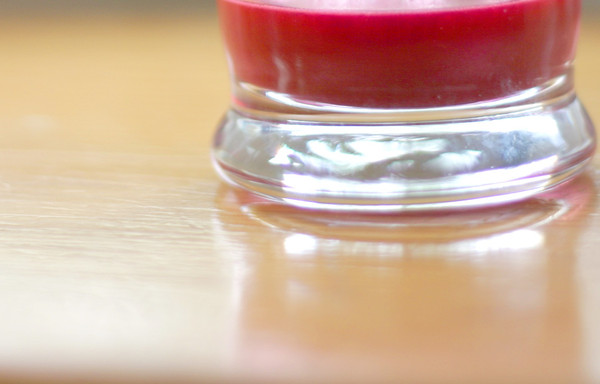
This is what “Creamy Grapefruit”, recipe 51 from The Big Book of Juices, looks like. It is absolutely, thoroughly delicious. Here’s what’s in (Mykala’s slightly modified) version:
One grapefruit
Two clementines
One (unusually) large beet
Four large carrots
1/2 ginger root
The clementines are in season right now and are a delicious, sweet addition. Anyhow, what we do is juice these ingredients using the Omega 8004 Commercial Masticating juicer. It runs at 80rpm, so it just crushes the juice out, instead of rapidly slicing and whipping a bunch of air in. This maintains the greatest amount of nutrients found in the raw foods. Before college, I wouldn’t have believed that whipping air had an adverse effect on micronutrients. However, after doing DNA assays where bubbles and foam had be to avoided to preserve the results, and after doing many many oxygen sensitive reactions, I can understand the importance of gently juicing and immediately consuming (rather than refrigerating) juices.
So, recently, Mykala and I changed our diet. We’ve eaten very little meat all along (maybe once every two months?), but after Mykala read T. Colin Campbell’s The China Study, and watched a movie that summarizes it quite well (Forks Over Knives), she came to another conclusion: over our lifespans (which are now quite long), eating animal products results in more harm than good.
Mykala led the way last year, going vegan in July. I went along, with the exception of milk. I tried to taper off my milk consumption (I just love it on cereal), but to give veganism a proper try, simply stopped it cold turkey in October. Since then I’ve been all vegan. I’ve eaten soy, oat, rice and other milks whose components I don’t recall.
Fat free soy milk is not good — it tastes sharp and feels really thin. Non-dairy egg nog can be excellent, but contains a truly shocking amount of sugar. My favorite soy milk right now is Silk® Light Soy Milk. My main concern: it is sweetened with stevia. Well, technically it is sweetened with reb_A, the sweetest of the stevia components. Reb_A is produced using the stevia plant as a starting point… then via water extraction, methanol/ethanol extraction, plus the necessary filtration. So, I’m not concerned about the production, (those are very well understood, relatively safe solvents) but rather about Reb_A itself. Reb_A seems safer than aspartame, but I don’t know if there’s enough information about it.
So, you’re probably wondering “Alex, no available food is completely safe, why don’t you just stick with the existing ingredients (dairy) in tons of foods, and make your life easier?” Well, safety is not an all-or-nothing road. When you start investigating food safety and nutrition, you have to make decisions based on nuanced, fact-heavy arguments. Otherwise, you’ll first drive yourself crazy, and then everyone around you, too. Here are the issues with consuming dairy:
T. Colin Campbell’s reproducible, small and large scale studies, showed serious issues with casein (in milk) and its action as a cancer promoter.
A truly extreme variety of processed foods contain dairy, including many of the foods with caloric densities in the stratosphere (anything with butter, etc.).
Powerful lobbies, like the National Dairy Council manipulate public perception of studies and fund their own. Campbell’s chapter “The Science of Industry” does a good job explicating the net negative result that well-funded industries with very specific interests have on the accuracy of the data disseminated to consumers.
Here are the issues with consuming soy milk:
Some varieties are made with soybeans produced using synthetic pesticides.
Some varieties have non-sugar sweeteners.
With these lists in mind, I’ve found it is easier to simply cut dairy out of my diet than try to reduce it down to a level where its carcinogenic effects are reduced. That is, if I tried to reduce, I’d be forever charting and tracking everything I ate, trying to see if the meal last weekend was so full of animal byproducts that I’d be best eating completely vegan for the coming week. Given the choice between (1) eliminating or (2) tracking the reduction of animal products in my diet, (1) is far simpler.
I choose not to eat animal products because there is no downside to not eating them. Such a statement generally causes consternation: “your health will be adversely affected”, “you won’t get nutrients you need”. Let’s go nutrient-by-nutrient, stating the potentially lacking nutrient in a vegan diet and then providing a solution:
Iodine — supplemented salt (i.e. most salt)
B12 — eat Cheerios (or any other supplemented cereal)
Iron — molasses, but also consider this fact: “the iron status of omnivores and vegans appears to be similar, and body absorption processes may adjust to low intakes over time by enhancing absorption efficiency”
Omega-3 fatty acids — three types: ALA, EPA, DHA. ALA from flaxseed, hazelnuts is converted by the body into the other types of omega-3s (EPA, DHA)
Then there is the protein. The argument that you won’t get enough protein as a vegan can be disproven in two ways, one scientific and one… not. First, anecdotally/non-scientific: I exercise with a tenacious regularity doing both intense, heavy weight-training and endurance stuff. Since going vegan, I’ve never felt a single adverse side-effect of muscle weakness or lengthened recovery. Heck, I’ve basically been eating no meat for years. My diet is not the factor limiting my endurance or muscular performance. Secondly, a more scientific argument, quoted from The China Study book:
The concept of [protein] quality really means the efficiency with which food proteins are used to promote growth. This would be well and good if the greatest efficiency equaled the greatest health, but it doesn’t, and that’s why the terms efficiency and quality are misleading. In fact, to give you a taste of what’s to come, there is a mountain of compelling research showing that “low-quality” plant protein, which allows for slow but steady synthesis of new proteins, is the healthiest type of protein.
…
People, for example, who choose to consume a plant-based diet will often ask, even today, “Where do I get my protein?” as if plants don’t have protein. Even if it is known that plants have protein, there is still the concern about its perceived quality. This has led people to believe that they must meticulously combine proteins from different plant sources during each meal so that they can mutually compensate for each other’s amino acid deficits. However, this is overstating the case. We now know that through enormously complex metabolic systems, the human body can derive all the essential amino acids from the natural variety of plant proteins that we encounter every day. It doesn’t require eating higher quantities of plant protein or meticulously planning every meal.
I’m comfortable with this choice of food for both the short and long term.