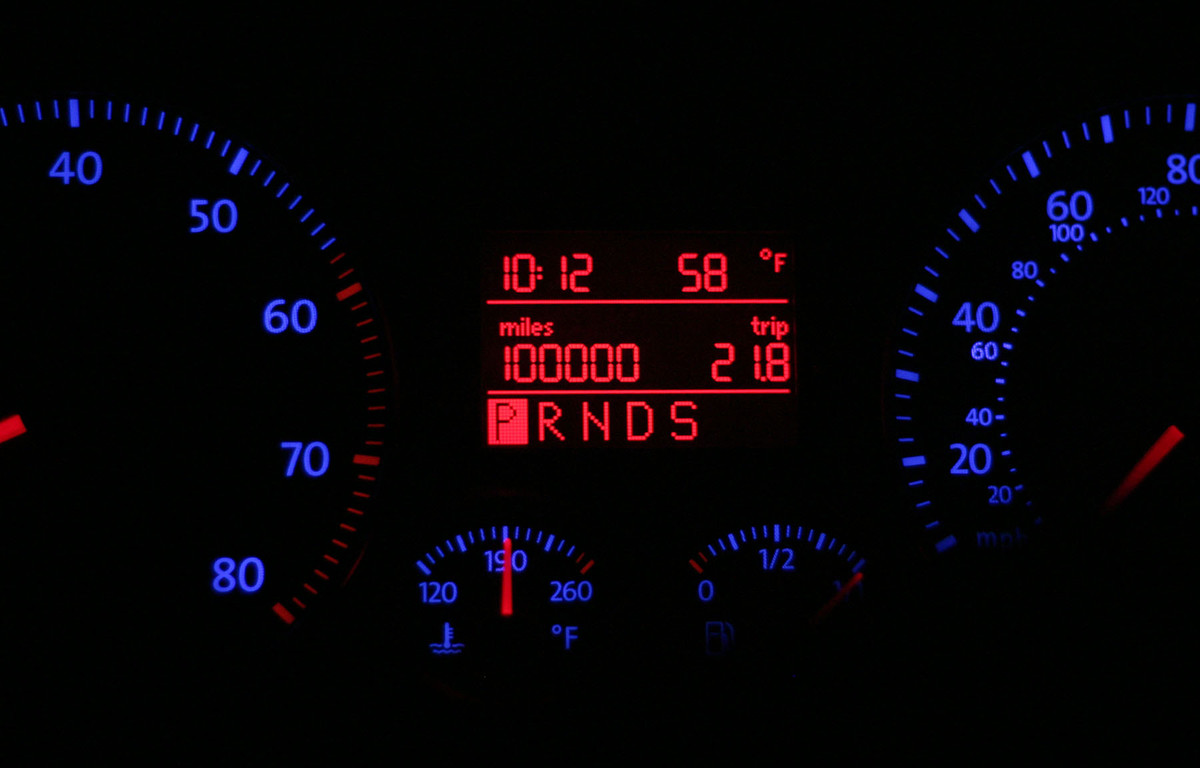
We were watching the odometer get closer and closer to the six digit milestone. I came home from work, and there was just over a mile left, so I waited for Mykala to get home… and yep, we drove aimlessly for a few minutes and made it.
Now, I have to get all the problems fixed on the car.
With my head in the sand of school, the world turned around me, and I kept my horizons narrow and focus tight. What I failed to realize was, well, mortality. You’re young and learning and the last thing you think of is your body—it does what you ask it to do, and it doesn’t sideline your plans with pain, inflexibility, or hospital stays.
My father is fighting cancer. My aunt died. My German teacher died. So, when Mykala and I drove back from Lutsen a few days ago, I looked a the gray sky a little differently. What would it be like if this winter was your last? What if this blizzard is the one you have to remember, and all others will just be walks you take in your mind? What if this Christmas marks the last time you set up the tree? What if, sometime soon, you’ll have to conjure the scent of balsam in your memory, hoping it will mask the acrid detergents and ethanol hand cleansers?
I want to understand the preciousness of my life, but I haven’t been able to do it consistently. Just one look at the bank statement or the loan consolidation, and I’m pulled right back into the everyday concerns of life. Out of the experiential and into the narrative. Yet I hope to avoid the amazing hypocrisy of both Ben Franklin and Samuel Pepys in my personal writing—they always seemed to espouse the virtues of qualities they did not have.
Anyhow, I’m listening to Bon Iver’s Re: Stacks, and Mykala is on her way home. This, too, is precious.
Unaccustomed as I am to air travel (“Oh my god I’m flying! I’m in a chair in the sky!”), much less business travel, it was a mostly new experience to go out to Boston this past Sunday and come back a little over 24 hours later. The purpose of my trip was to learn more about the Bicon implant system, and I was actually comfortable accepting a trip, hotel stay, and continuing education credits from a company for whom I do not work. Why? Isn’t that some type of conflict of interest? It could be, but I had already, during my last year of school, done the research and decided that this system offered the best dental implants for most situations.
Leaning heavily on the experience of professors I trusted, I made the Bicon choice, and I’ve decided to relentlessly pursue this thing—not to stop until I get to a job where I can work with these implants regularly. I’m happy doing dentistry, but sometimes I get, frankly, pissed off and kind of offended with the profession; I keep seeing teeth break off, get fillings, break off further, need root canals, get covered with crowns, break off again, need another root canal and a post and a crown, with each time period between major dental interventions shortening. It is, in my opinion, absolute insanity that insurance will pay for some of the bat-shit crazy treatments people get to save their “natural” teeth, when an implant will serve their needs (chewing, not hurting) for far longer, and cheaper over that time period.
So, the implant treatments I want to see patients get, the ones that last, the ones that are a good investment and represent the best our profession has to offer, are not covered by insurance. I don’t know how to fix that problem, and this isn’t the time, but I do know it’s time for me to learn everything I can about implants.
So, let’s see, where was I? “Charting the right course,” that’s it. I ended my last post with that seemingly-dull platitude, but I realized I hadn’t fully articulated that idea. Here we go.
The more I work building tiny things in a very forbidding environment, the more I value planning and preparation. Bah, here we go into platitude country again. Let me try again: you can’t do good work on a bad foundation. That’s better. Yeah, let’s run with that analogy.
Let’s say you’re a general contractor, and you know your materials and your workers. You know how to get a roof put on exactly right, how to find the best workers to pour (or, assemble from precast concrete) a crack-free foundation. You know where to put conduits so the house can be modified in the future. You who to call to get drywall finished to level 5 awesomeness. So, you get called in at the beginning of a job. “Build a house here,” they say. “But I can’t! That’s a, well it’s a swamp.” “I told the property owner we could do it, so do it.” “Umm.”
Doesn’t matter how nice you make that foundation, or the great things you build on top—if conditions were poorly chosen for the task (building a house), all of your hard work will be wasted. You’ll blow huge amounts of effort and time trying to make it work. The thing was doomed from the start.
On a smaller scale, it’s like asking the area’s best tile layer to redo your shower even though your studs are rotting behind it. The work won’t last! You’ll be disappointed, he’ll be irate. Plan it first!
So, when I say “charting the right course”—this is what I mean. I’m so confident this idea applies to all areas of life, I’ll put it in a blockquote:
Plan twice as much as you work.
Otherwise, you’ll lose confidence, and waste everyone’s time.
Instead of wildly speculating, thoughtfully considering, or analogically writing about life as a dentist, I’ve actually been doing it for the past few weeks. Such a disconnect between writing and experience is precisely the reason I’ve tried to make it so easy to post things in this space and exactly why I am troubled when I do not. That is to say: I don’t want to look back and forget what life was like, so I seek to write it out here. And yet, when I seem to be living the most life, I’m not writing… I’m out living. Like coming back with no pictures of your great tour of Europe, because it was too exciting to stop for photos. I guess I’m someone who isn’t confident that memories in one’s head are good enough souvenirs of a life well-lived.
Immediately after getting married, I wrote little. When I did, it was nothing proportional to the magnitude of life changes I was experiencing. Yet, I remember that period with great fondness — moving in with Mykala for the first time, learning how our lives were going to look together, returning from our honeymoon to a house that was only half moved-in to, yet on its way to becoming a home. My memories of that time are rich, but I wish my writings were equally so.
Now, I am slowly going from being a student to being a not-student. I enter the dental operatory with my mask already on 99% of the time, which has helped to avoid the blatant questioning of my experience or the impossible-to-hide disappoint on some patient’s faces: Oh crap, I got the new guy. Spending all of my work-week in mouths has made me become surer in my actions, which seems to calm down those who may be wondering if they should reschedule with someone else. The other day, I was demonstrating something to Mykala and she told me I was “touching her face like a dentist,” which was actually kind of nice — like, hey, I’m learning some of those subtle things you do when you gain experience!
So, what else would I like to capture about this time; what feeling (that I might remember as a vague sense of this time) do I want to pin down and articulate, sharpening my understanding of “now” for future Alex? Well, I’ve started to get better at handling composite (tooth colored filling material), to the point where I’m actually satisfied with my work. It’s not that it wasn’t OK before, I’m just… insanely picky about my work. Really, really picky. Little stuff, stuff I know patients can’t see, bugs me. I want things to be not just OK, not just long-lasting, but awesome. So I guess I’ve also realized that I am really really perfectionistic, and this drives me from tooth to tooth to refine refine refine. This is excellent news for my career, because I’ve many years of doing the same thing—and that excites me. Most of all, the exposure of going from mouth to mouth, person to person, is helping to hone my instinct for what is normal and what is pathological. Being able to place your patients in a context, put them on a continuum, helps you make better decisions.
And really, I think this is true of any pursuit of excellence: you need to know how what you are doing fits into the tapestry of your profession, only then can you chart the right course.
“You’ve got to realize the world is a big place—try not to be so up tight.”
After his frank indictment of my character, I stared blankly at Mr. Mortenson, my high school physics teacher and tennis coach. His classroom had the idiosyncrasies of a long-occupied room: a non-standard office attached to the back wall, lined with 20-year-old physics instruction adjuncts and old tennis rackets. We had just handed in another assignment, on which I was accustomed to acing, but had flubbed a sign or made some minor error. I’m sure I looked crushed by my mistake and was redoubling my efforts and asking questions to get the concept right. I really didn’t like any grade less than 100%.
This wasn’t the first piece of advice from Mr. Mortenson. I remember a lecture about Newton’s Laws when he tied in Semisonic’s song Closing Time:
Every new beginning comes from some other beginning’s end
“That’s physics!”, he said. Perhaps it was because he was nearing retirement and his quoting a popular song was almost anachronistic, or perhaps it was because he refused to just focus on physics and instead say something more. I see now that he didn’t want to be limited to dry, rote block-on-incline-plane stuff. No, Mr. Mortenson sometimes actually said stuff that applied to our lives, lives we’d soon be out living.
And then, since it was so unusual to hear anything that applied to the real world, he said something I’m still surprised by today: “Touch the world gently, and it will touch you back gently.” Googling this now, I would guess that it comes from Javan’s 1984 book Something to Someone. But keep in mind, I was coming up on 12 years of education without any teachers talking to me like I’d end up in the real world, and here’s some life advice flying into my head in the middle of a physics lecture.
Given his record for slipping gold into black sand, you’d like to think I immediately took Mr. Mortenson’s “up tight” comment to heart. Fact is, though I remember his comment 10 years later, I did not at all understand it when I first heard it. I couldn’t see that there could be more than jumping through the hoops, that I was just a “really excellent sheep”. I’m glad I remember his words.
The ex-potato field felt empty but not desolate—lot stakes, light posts, and the bafflingly windy streets of modern suburbia were all in place. Ours was the second house in Brighton’s Landing, a development in what would soon become one of the fastest growing cities in the nation. I knew none of this context, nor would it have refined my picture of my place in the world—like any child, my life was defined by low walls and narrow vistas. But I did know we were moving, here, to this new house. I gazed up into the vaulted entryway, looked down at the unstained ornaments for the front window. My memories of this construction phase are spotty, but I know we visited regularly during dim fall evenings. I remember little from the days we moved, but the vast expanse of fresh carpet lodged in my brain. Perhaps because I was six years old and still close the ground. That was 1991, over 20 years ago.
I believe I have one very special memory, though. I say “believe”, because this is one of those memories where you can’t tell if your brain fabricated it for you while listening to the retelling of the event, or if it is authentic. I maintain a fervent hope this memory is no interloper into the vessel of memory: my sister and I are in a car, and the overwhelming emotion is “safe”. It’s in the air. I can’t tell you the model of the car or the time of day, but this emotion I recall more than anything. My grandma is there. Safe. We are outside the old house, and we say “goodbye house.” And then, we leave. This is exactly how one wants to feel before going on a journey, before moving, before beginning something new. Safe and loved and whole, surrounded by this vibrant, palpable love.
That house to which we moved, the one in which my parents still live, sits at the top of four circular terraces, descending the height of an 80 story building down to a lake. During that first winter, we could grab a sled and cut a clean line through what would soon become dozens of houses and yards and fences. All there was was white; no landmarks, no chimneys, just white and the deafening silence of snowy land. Our sleds were blue with yellow handles and we rushed to buy a fake christmas tree in the last days before the holiday. In the summer, we played on a giant dirt pile from the excavation of a neighbor’s foundation, skidded our bikes in circles in the gravel at the end of the new street, admired the green of our new sod next to the brown that surrounded us. This situation became a defining dichotomy of my childhood—the shelter that comes from the prosperity and optimism of flourishing suburbia juxtaposed to the timeless freedom that stems from roaming pastoral countryside.
So, 20 years. I come to this realization by way of a roof—that house I grew up in got a new roof yesterday. Another 20-year roof. And sitting there, talking with my mom, I did the mental math. I’ll be 47 years old when that house needs a roof once more. Somehow, making this calculation pushed the cold indifference of time right into my face, and it set me back on my heels. Can that be right? I’ll be almost 50 when this place needs a roof again?
At some point before I started college, I stopped living in the moment. I can glorify the memory, but I fail to enjoy making it. My writing falls short of imparting how I feel, but I’ll keep practicing, practicing the introspection needed to improve oneself. Now, I no longer want to improve just for the sake of improving, but instead with a hope that I can tune myself to the present.
On this ancient and miraculous world, where such
beautiful natural and living things have evolved,
something has gone wrong when life itself is used as a
manufacturing process. I read that in 50 years, we must
adopt a largely vegetarian diet or die, and forgive me if
I take that as good news.